Product development for non-technical founders building digital products

Key challenges founders face when building a product
For many non-technical founders, turning an idea into a working digital product begins with a series of decisions that must be made long before there is enough clarity or real-world evidence to support them. Product direction, technical strategy, and delivery expectations are often defined in parallel, even though assumptions around user value, feasibility, and scope remain untested.
At this early stage, the process is shaped by time pressure, uncertainty, and limited access to reliable technical expertise. As a result, founders face challenges that are less about execution and more about making the right product and technical decisions at the right time.
The most common of these challenges fall into three closely related areas.
Early architecture decisions under uncertainty
In the very first stage of making a product, founders face choices that affect the product's long-term direction even though key ideas haven't been proven yet. Architecture, technology stack, interfaces, and scalability are often talked about before people really understand what the users need, how they will use it, or the business model.
This creates a structural challenge. Simplified early solutions can restrict future development and require significant rework once the product gains traction. More complex technical setups increase cost, extend delivery timelines, and introduce maintenance overhead before the product demonstrates real value. Each direction carries consequences that are difficult to fully assess at this stage.
External factors, including current technological advancements, individual implementation preferences, or projections of future scale, can occasionally shape early architectural decisions in real-world scenarios. Decisions that do not align with the aims of the existing product pose several dangers:
When compared to their validation objective, MVPs become over-engineered.
Tight connections between core components limit flexibility.
Early accumulation of technical complexity slows iteration once user input is accessible.
Making selections that fit the product's present stage is essential to effective early-stage architecture. When teams have defined priorities, a well-managed scope, and a clear understanding of which decisions must remain open, they can proceed with confidence. A well-thought-out technological basis facilitates quick learning in the near term while maintaining the flexibility to adapt when actual usage data and business needs change.
Pressure to launch before assumptions are validated
Product development is conducted within an environment where significant progress is consistently monitored. Prototypes, demonstrations, and initial releases serve as tangible deliverables that are commonly utilized by investors, accelerators, partners, and prospective clients to assess progress.
This dynamic expedites decision-making processes and accelerates delivery schedules. Teams may commence development despite remaining uncertainties, allocate less time to discovery, or prioritize rapid delivery over a shared understanding of the problem.
Patterns seen across failed early products tend to repeat themselves. When teams move quickly without a clear understanding of what they are trying to learn or validate, market feedback becomes difficult to use. Releases may happen on time, yet the signals they produce offer little guidance for the next decision.
In these situations, similar issues tend to surface across teams:
Features begin to diverge from how people actually use the product in real situations, even if they seem reasonable during planning.
Teams and stakeholders often evaluate progress through different lenses, which leads to confusion around what success actually looks like.
Iteration gradually becomes reactive, shaped by the most recent feedback or metric rather than by a clear set of priorities.
Early versions of a product tend to be most effective when there is a specific intent behind each release. When teams agree in advance on what they are trying to learn and how outcomes will be assessed, progress becomes easier to interpret. Instead of adding noise, each release contributes insight that helps guide the next decision.
Lack of integrated technical and product guidance
Founders often turn to external specialists to move product development forward. This can include freelancers, agencies, or technical advisors who contribute to implementation and help make early technical choices. In practice, this setup solves short-term execution needs, but it also introduces new challenges around ownership and direction.
Advice received from different contributors is not always easy to interpret or compare. Technical input may be detailed and confident, yet focused narrowly on how something can be built, without enough discussion around cost implications, long-term impact, or alternative approaches. As a result, decisions are made piece by piece rather than as part of a broader product strategy.
In these situations, teams tend to run into a familiar set of issues:
Uncertainty around which decisions require immediate attention and which can reasonably wait.
Limited understanding of trade-offs behind technical choices and the constraints they introduce.
Increasing reliance on individual contributors to set direction, rather than to execute against it.
Over time, this affects how product ownership is exercised. Planning becomes centered on coordinating delivery and resolving short-term questions, while deeper product direction receives less attention. Confidence in long-term decisions gradually erodes as context becomes fragmented.
Product development moves more effectively when technical thinking is connected to product intent. When business priorities, user needs, and technical decisions are discussed together, teams develop a shared frame of reference. This alignment supports consistency in decision-making and helps progress remain deliberate rather than reactive across the product's lifecycle.
:format(webp))
What must be defined before development begins
Before development starts, clarity plays a decisive role in product progress and delivery efficiency. This phase establishes shared understanding across business, product, and technical perspectives. When key elements remain undefined, delivery speed decreases, costs increase, and learning becomes fragmented.
Three areas require particular attention at this stage.
Clear problem definition grounded in real behaviour and decisions
A clear problem definition provides a shared reference point for every decision made during product development. At this stage, the goal is to move beyond abstract ideas and describe the problem as it appears in real situations, based on observable behavior and decision-making patterns.
The diagram below illustrates how an initial idea evolves into a validated problem statement. It shows the progression from early assumptions to concrete insights derived from real observations and interactions.
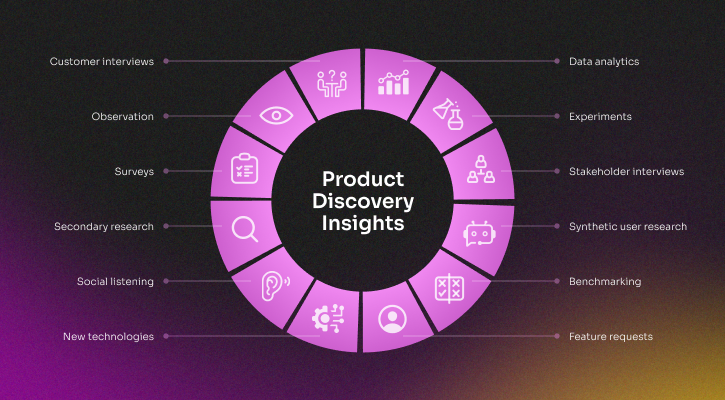
This progression helps teams align around what is actually being addressed. Instead of treating assumptions as fixed truths, they are examined and refined based on inputs drawn from real contexts.
At this stage, insight typically comes from a combination of sources, such as:
Conversations with users or stakeholders focused on context rather than opinions.
Observation of existing workflows, tools, or alternatives people already use.
Analysis of support requests, feature requests, or recurring questions.
Internal domain knowledge and experience from similar products or markets.
Competitive and comparative analysis to understand established patterns.
These inputs help define the boundaries of the problem and clarify what success should look like from the user's perspective.
To deepen this understanding, it is useful to look at how decisions unfold over time. The visual below represents a simplified decision journey, highlighting triggers, actions, and outcomes that influence behavior in real scenarios.
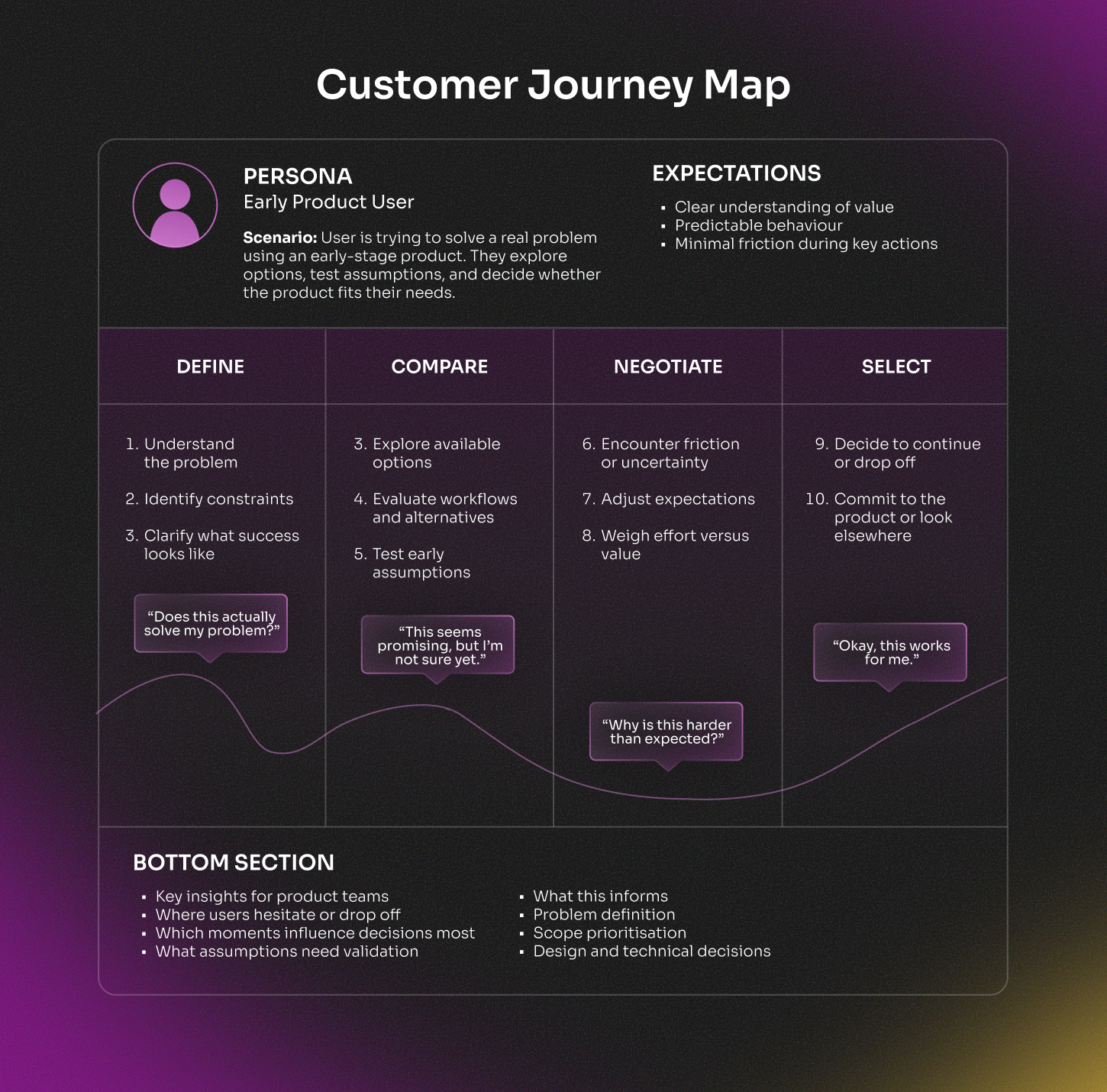
By mapping behavior and decisions in this way, teams gain clarity on where friction occurs, what motivates action, and which moments matter most. This level of insight supports precise problem definition and ensures that subsequent design and development efforts address real needs rather than inferred ones.
Prioritised functional scope for the first release
Once the problem has been agreed on, attention naturally shifts to what should be built first. At this stage, the discussion is less about completeness and more about focus. The task is to define a first release that can be delivered, understood, and evaluated without introducing unnecessary complexity.
In practice, teams often struggle at this point because everything can feel important. Features that seem "small" or "nice to have" quickly accumulate and blur the purpose of the initial release. To avoid this, scope is deliberately framed around depth rather than breadth.
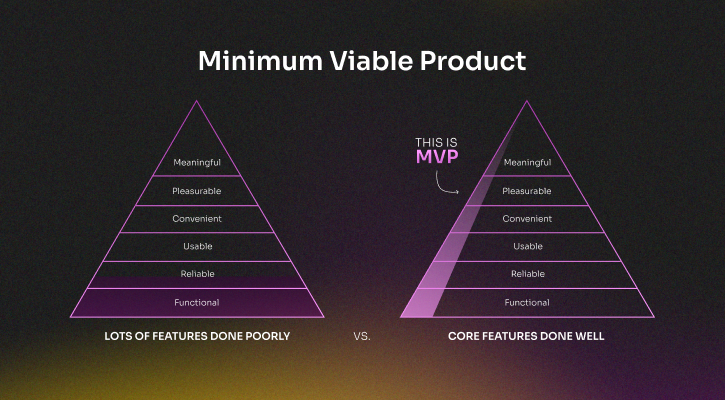
The visual above reflects a common way to think about an initial release. Instead of attempting to deliver many features at a shallow level, the focus is placed on a smaller set of core capabilities that are implemented properly. Reliability, usability, and clarity take precedence over feature count.
In this model, scope is typically considered across three layers:
Core functionality that enables the primary user outcome and defines the product's purpose.
Supporting features that improve usability, stability, or confidence without changing the core value.
Additional capabilities that extend the product but can be safely deferred.
Making this separation explicit helps teams explain why certain features are included now, why others are postponed, and how future expansion is expected to happen. It also reduces the risk of overloading the first release with partially finished functionality.
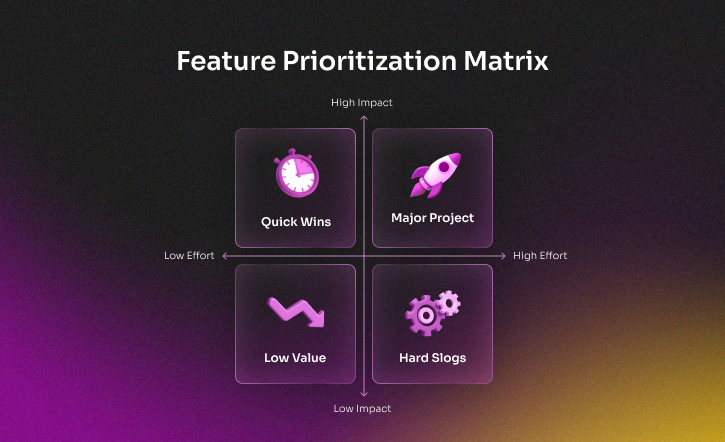
Once scope layers are defined, teams still need a practical way to make trade-offs. This is where a simple prioritization framework becomes useful. The matrix shown here compares potential features based on expected impact and implementation effort.
Rather than debating features in isolation, this approach encourages structured discussion. High-impact items that can be delivered with reasonable effort are prioritized, while features that require significant work with limited immediate value are intentionally delayed. This helps keep the initial release focused and realistic.
A prioritized functional scope is more than a feature list. It creates shared understanding, limits scope creep, and provides a clear foundation for development. With a focused first release, teams can gather meaningful feedback, communicate progress clearly, and adapt the product with confidence as it moves beyond its initial version.
Technical feasibility and early development risks
Before development begins, teams need a clear understanding of how the product can realistically be built. Technical feasibility at this stage is not about detailed implementation but about making constraints, dependencies, and risks visible early enough to influence decisions.
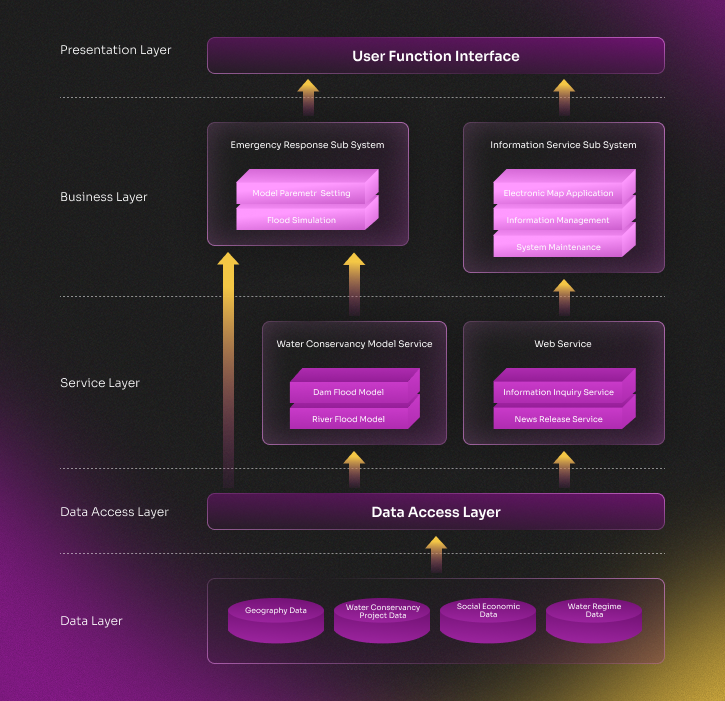
The first step is forming a common understanding of the product's technical shape. A high-level architecture view helps clarify which parts of the system are core, how responsibilities are separated, and where external services or integrations come into play.
This kind of representation allows both technical and non-technical stakeholders to reason about the system at the same level. It makes data flows, dependencies, and boundaries explicit without going into implementation details. As a result, conversations about scope, timelines, and complexity are grounded in a shared technical context rather than assumptions.
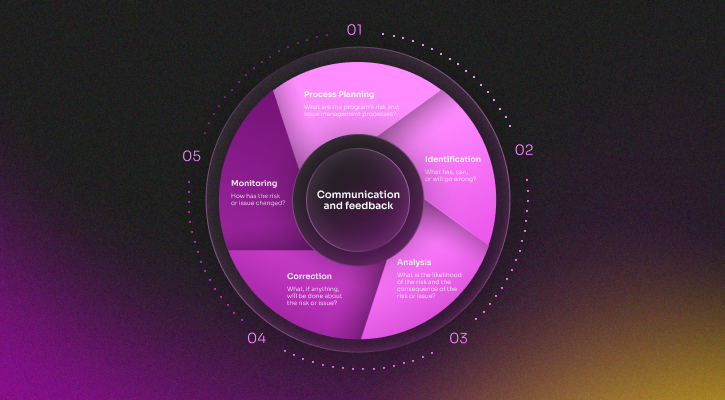
Beyond the overall structure, feasibility work also brings attention to areas that may create friction later. At this point, teams usually surface assumptions, external dependencies, or technical constraints that could affect delivery once development is underway.
Calling these risks out early changes the nature of the conversation. Instead of encountering issues during implementation, teams can discuss them in advance and decide which ones need immediate attention, which should be tracked over time, and which are acceptable for an initial release.
This early clarity makes planning more grounded. Estimates become easier to reason about, priorities are simpler to explain, and mitigation steps can be introduced without disrupting progress. As a result, development moves forward with fewer late surprises and a stronger sense of control.
How we approach product development in real projects
Product development at Leetio follows a structured sequence of informed decisions. Each stage of the process is designed to help teams navigate uncertainty, stay aligned, and establish a product foundation that supports continuous learning and long-term growth.
Our approach brings together discovery, technical strategy, design, and delivery into a single workflow, ensuring that business objectives remain closely connected to practical execution.
Discovery and clarification of early product assumptions
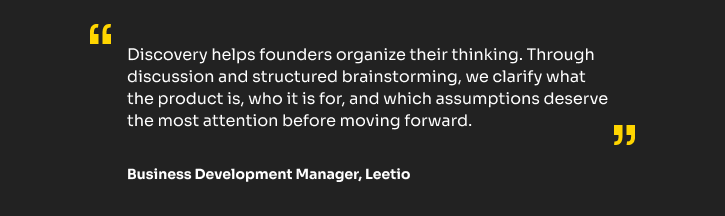
Discovery is treated as a structured thinking phase that helps founders bring clarity to early product decisions. The focus is on organizing initial ideas, sharpening the product vision, and surfacing the assumptions that shape direction at the earliest stage.
This phase is built around focused discussions and expert-driven workshops. We work closely with founders to explore the idea from multiple angles, challenge initial perspectives, and shape a clearer understanding of what the product aims to achieve.
We focus our attention on clarifying a small set of foundational decisions during the discovery phase:
Defining the problem in concrete terms, so it can be discussed and evaluated consistently.
Establishing who the product is being built for and in which situations it is expected to be used.
Surfacing assumptions related to value, functionality, and technical constraints.
Identifying areas of uncertainty that are likely to influence early product choices.
The outcome of this phase is a shared product vision, a clearly articulated set of assumptions, and defined focus areas that guide technical strategy, design decisions, and development priorities. This ensures that subsequent work is grounded in clarity rather than driven by fragmented ideas or unexamined expectations.
Architecture and technology decisions for scalable products
Once the initial product direction is clear, technical questions start to surface naturally. Founders need to understand how the product can be built today without limiting what it may need to become later. This is the point where a technology strategy takes shape.
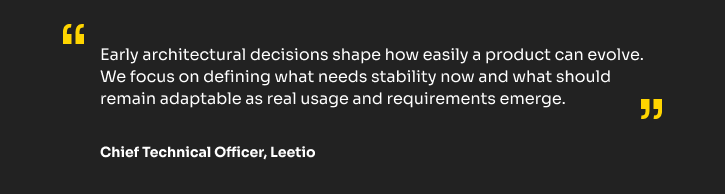
Architectural thinking at this stage is intentionally high-level. The focus is not on how features will be implemented line by line, but on how the system should be organized, where boundaries sit, and which decisions need to be fixed early versus left open.
In practice, this means working through a small number of fundamental technical choices:
How the overall system is structured given the current scope and maturity of the product.
Which technologies make sense based on functional needs, constraints, and team capabilities.
Where the product depends on third-party services or external integrations.
What early considerations around performance, security, or scale should be taken into account.
These decisions are written down and treated as working agreements rather than final answers. As the product evolves and real usage emerges, they are reviewed and adjusted, keeping technical direction consistent instead of reactive.
Approached this way, architecture becomes a support mechanism rather than a constraint. It reduces unnecessary rework, makes change easier to manage, and gives the product a technical foundation that can grow without constant restructuring.
Product design and prototyping to align decisions before development
Once the product direction and technical boundaries are clear, design becomes a way to make decisions tangible. This stage helps teams move from abstract discussions to concrete interaction scenarios that can be reviewed, questioned, and refined before development begins.
Design work focuses on clarifying how the product is expected to be used in practice. Instead of aiming for visual completeness, the goal is to make product behaviour explicit and understandable across all stakeholders.
At this stage, design helps establish:
How users move through the core flows that deliver the primary value.
Which interface patterns support essential functionality without unnecessary complexity.
How key interactions behave across typical usage scenarios.
Interactive prototypes play a central role in this process. They give founders, designers, and engineers a shared reference point and allow decisions to be explored through interaction rather than interpretation. Gaps, assumptions, and unclear areas become visible early, while changes are still inexpensive to make.
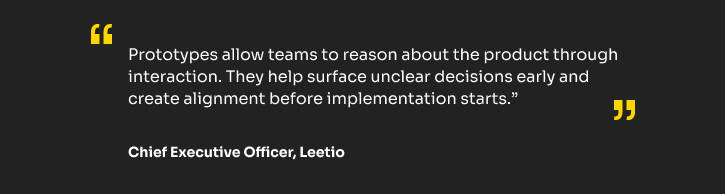
By grounding discussions in concrete interaction scenarios, this stage reduces ambiguity during development, supports more confident prioritisation, and creates a smoother transition from planning into implementation.
Development, testing, and controlled product delivery
Development is the point where earlier decisions start to carry real weight. Instead of expanding scope, the work centres on delivering a first version of the product that is usable, stable, and aligned with the priorities already defined. This first release is treated as an MVP, not as a draft or technical experiment.
Work is planned to stay predictable. Scope is kept deliberately narrow, focusing only on what the initial release needs in order to function and be evaluated meaningfully. Quality and stability are treated as baseline requirements, not trade-offs.
In practical terms, this usually means:
Shaping the backlog around MVP goals rather than feature volume.
Building in line with agreed architectural constraints.
Testing critical user flows as they are implemented.
Releasing in small, reviewable increments.
Testing is part of everyday development work, not a separate phase at the end. This helps catch issues while changes are still easy to make and keeps the product aligned with its intended behaviour as new functionality is added.
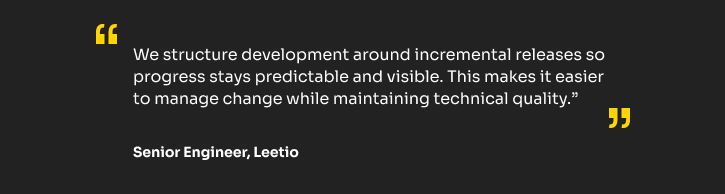
The outcome of this phase is a working MVP that can be released, observed in real use, and improved with confidence. Each release builds on what already exists, supporting learning and iteration instead of acting as a one-off milestone.
What founders gain from a decision-driven product process
A structured product development approach creates value beyond delivery speed or feature completeness. It shapes how decisions are made, how risk is managed, and how confidently a product can evolve. For founders, this translates into clearer expectations, stronger control, and a foundation that supports both execution and growth.
Predictable timelines and lower uncertainty
One of the primary challenges founders face during product development is uncertainty around progress, timelines, and outcomes. When work lacks structure or visibility, planning becomes reactive and confidence erodes.
This approach establishes predictability through clearly defined phases, explicit priorities, and measurable milestones. Progress is communicated through regular reviews, shared artefacts, and visible delivery increments. Decisions are documented, trade-offs are explained, and risks are surfaced early.
As a result, founders gain:
Realistic timelines grounded in validated scope and feasibility.
Continuous visibility into progress and decision rationale.
Fewer unexpected delays driven by late-stage discoveries.
Reduced uncertainty enables more confident planning and stronger alignment across stakeholders.
Roadmaps without early technical debt
Early development decisions have a lasting impact on a product's ability to evolve. When scope, architecture, and priorities are defined without structure, technical debt accumulates quickly and limits future options.
This approach emphasises intentional decision-making and controlled complexity. Roadmaps are shaped around validated learning goals, while architectural choices prioritise flexibility and clarity. Technical decisions are revisited as new information emerges, preventing rigid structures from forming too early.
This results in:
A roadmap aligned with product maturity rather than assumptions.
Technical decisions that support iteration and change.
Reduced need for disruptive refactoring as the product grows.
A roadmap built in this way supports progress without constraining future development.
A foundation built for growth and investment readiness
Scalability extends beyond infrastructure. It includes team processes, system structure, documentation, and the ability to adapt to new requirements. A product built with these considerations in mind remains resilient as usage, complexity, and expectations increase.
This approach establishes a foundation that supports:
Modular system architecture and clear ownership.
Consistent delivery practices and quality standards.
Documented decisions that provide context for future teams.
For founders, this creates readiness for growth initiatives, partnerships, and investment discussions. The product can be explained, evaluated, and evolved with confidence, supported by a clear history of decisions and a stable technical base.
:format(webp))
How this approach works in real product scenarios
While every product journey is different, the challenges founders face often follow similar patterns. The cases below illustrate how the Leetio approach adapts to different starting points while preserving structure, clarity, and decision control.
Case 1: Starting with an idea and no technical foundation
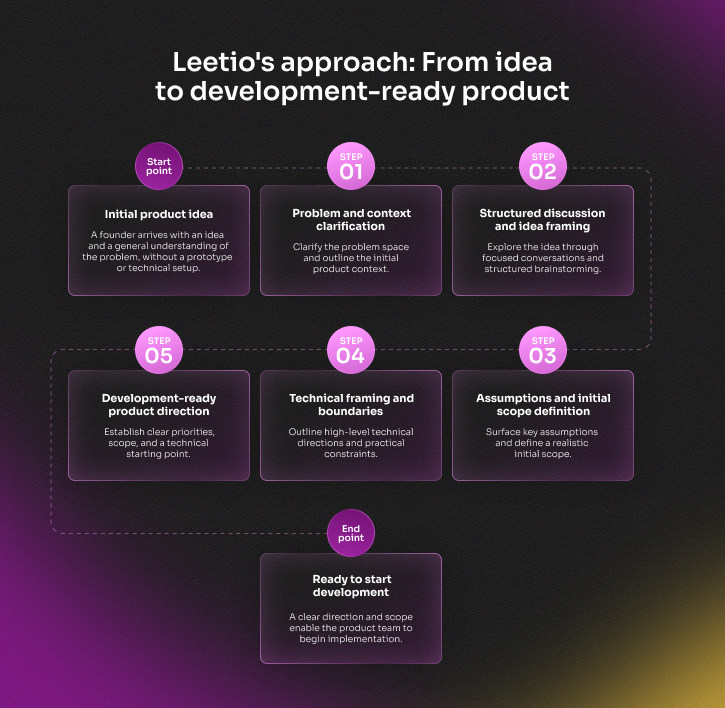
This is one of the most common starting points we see. A founder comes with a clear idea and a strong sense of the problem they want to solve, but much of the product detail is still unformed. There is no prototype, no technical setup, and no clear understanding yet of what needs to be built first.
At this stage, the boundaries between scope, priorities, and technical direction often become blurred. The challenge lies in translating a high-level concept into a structured product direction without committing to technical or implementation decisions too early.
Work in these cases begins with bringing clarity and structure to the conversation. The focus is on helping the founder define what needs attention now and what can reasonably be addressed later, so early decisions support progress without narrowing future options too early.
Our involvement at this stage typically includes:
Collaborative discussions to clarify product vision and intended value.
Structured brainstorming to explore possible approaches and delivery paths.
Identifying assumptions that influence early product and technical decisions.
Defining an initial scope aligned with current understanding and constraints.
Outlining high-level technical boundaries that inform future development.
Once this foundation is in place, it becomes possible to move confidently into development. The structured scope and technical framing provide a clear starting point for building the first version of the product, while leaving room for iteration as real usage and feedback emerge.
The result is a defined product direction, a realistic initial scope, and a clear transition into development. Founders move forward with a roadmap that supports informed decisions around time, budget, and priorities, and a product team that can begin implementation without uncertainty around what should be built first.
Case 2: Stabilising an early prototype and regaining control
This situation usually appears after a fast first build. A prototype already exists and may demonstrate the core idea, but it was built quickly and without a clear technical or product framework. While parts of the product work, the overall system often lacks consistency, stability, or a clear direction for further development.
At this stage, teams usually feel the tension between moving forward and fixing what already exists. The prototype carries value, but it also introduces uncertainty: unclear architecture, fragile integrations, and growing difficulty in making changes without breaking something else.
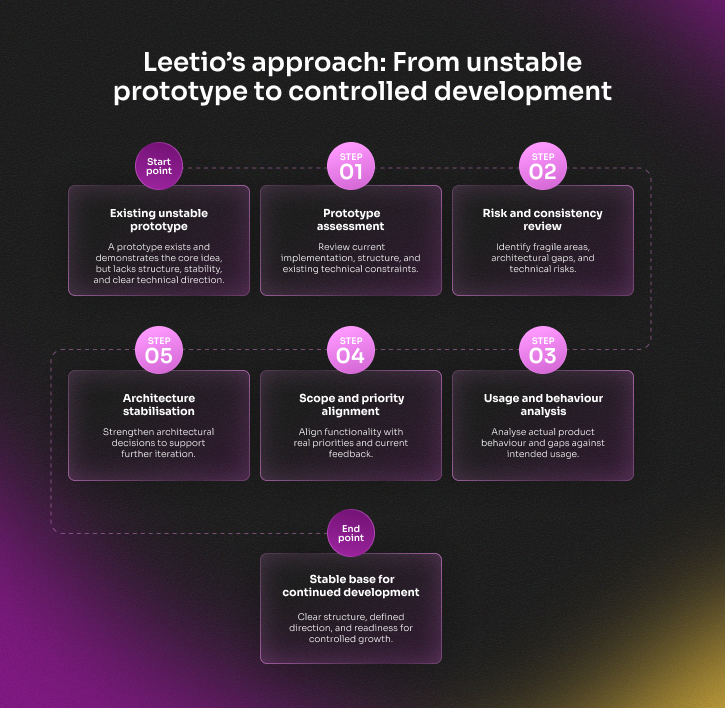
Our work in these cases focuses on restoring control and creating a reliable foundation for continued development. We typically start by examining the existing prototype to understand what is there and how it behaves in practice. This allows us to separate reusable elements from areas that introduce risk or unnecessary complexity.
Our involvement usually includes:
Reviewing the current implementation to assess structure, dependencies, and technical risks.
Clarifying product goals and identifying gaps between intended behaviour and actual usage.
Revisiting scope to align functionality with real priorities and feedback.
Adjusting or restructuring architectural decisions to support stability and future iteration.
Throughout this process, existing work is preserved where it makes sense. The goal is not to discard effort, but to bring product and technical decisions back into alignment so development can continue without accumulating further risk.
By the end of this phase, the product has a clearer structure and a defined technical direction. The team regains confidence in making changes, priorities become easier to manage, and development can move forward in a controlled way. This prepares the product for further iteration, broader testing, or market entry without repeating the same instability that emerged earlier.
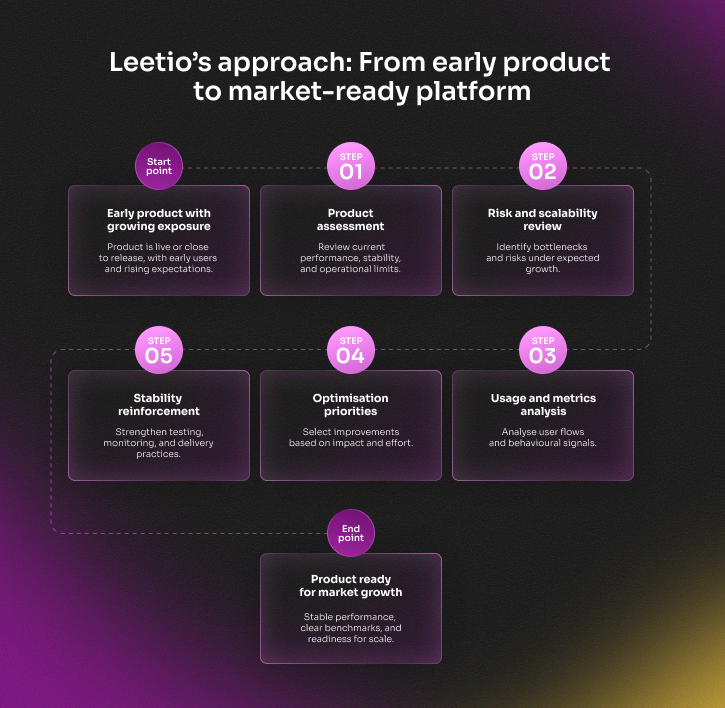
Case 3: Preparing an early product for growth and market entry
This situation usually appears when a product is already live or very close to release. Early users or pilot customers are engaged, and the core functionality is in place. At the same time, questions begin to surface around performance, scalability, and reliability as expectations around wider usage increase.
At this stage, uncertainty is less about what to build and more about whether the product can handle growth without disrupting user experience or delivery momentum. Metrics may exist, but they are not always clear or actionable. Technical limitations start to affect confidence in broader rollout.
Work in these cases focuses on strengthening the product before exposure increases. The goal is to ensure that growth does not introduce instability and that technical and operational foundations can support the next stage of the product lifecycle.
Our involvement typically includes:
Assessing system performance, scalability, and operational risks.
Reviewing analytics, user flows, and behavioural signals.
Prioritising optimisation efforts based on impact and effort.
Refining delivery and testing practices to improve stability and predictability.
Optimisation is approached as a targeted process rather than a broad rewrite. Attention is directed to the areas that limit growth, affect reliability, or create uncertainty around performance. This allows the product to improve without disrupting existing users or delivery rhythm.
By the end of this phase, the product is more resilient and easier to operate at scale. Performance benchmarks are clearer, risks are better understood, and the team has greater confidence in supporting growth. This creates stronger readiness for broader market entry, partnerships, or investment discussions.
What these cases have in common
Across all scenarios, the same core principles remain consistent:
Clarity before execution: Product, technical, and scope decisions are made explicit before significant development effort begins.
Flexible technical direction: Technical strategy is designed to support change and learning as the product evolves, without locking teams into rigid solutions.
Structured and visible progress: Work is organised around clear priorities, with progress, risks, and trade-offs visible to all stakeholders.
Controlled decision-making: Each stage reduces uncertainty instead of accumulating it, allowing teams to move forward with confidence.
This consistency allows Leetio to support founders at different stages of product development while maintaining focus on long-term product stability, adaptability, and growth.
Final Thoughts
Building a digital product without a technical background requires navigating a series of decisions made under uncertainty. Early choices regarding scope, architecture, and delivery significantly influence how a product evolves once real usage, constraints, and complexity emerge.
Throughout this article, we have outlined a structured approach to product creation. The focus remains on establishing clarity before execution, making intentional technical decisions, and maintaining steady progress through transparency and shared understanding. This structure provides a practical way to manage uncertainty as the product evolves.
For founders, this approach leads to clearer priorities, realistic expectations, and a product foundation that supports learning and growth over time. For teams, it creates alignment between business and technical perspectives, reducing friction as the product matures.
If you are working on a product idea, recovering an unstable prototype, or preparing an early product for growth, Leetio can support you through these stages. We help founders structure decisions, define technical direction, and move into development with clarity and control.
Get in touch with Leetio to discuss your product, your current challenges, and how we can support the next step of your product journey.
FAQ
- Leetio supports founders through the early and most uncertain stages of product creation. We help structure product decisions, define technical direction, and translate business goals into a clear development plan. Our role sits between strategy and execution, ensuring that development starts with clarity rather than assumptions.
- No. Many founders come with an initial concept that still lacks structure. We help shape that idea into a clear product direction by working through scope, priorities, and technical considerations. The goal is to establish enough clarity to begin development with confidence.
- Founders involve Leetio whenever they need clarity around product direction, technical decisions, or delivery. This may happen at the idea stage, during active development, or when a product is already live and evolving. Our involvement adapts to the current state of the product, while the core approach remains the same: structuring decisions, aligning technical direction with product goals, and supporting controlled progress.
- Product and technical decisions are treated as shared responsibility. Scope, priorities, and architecture are defined deliberately, documented, and revisited as the product evolves. This helps teams move forward with clarity while remaining flexible as requirements and usage change.
- Leetio works as a long-term product and engineering partner rather than a task-based execution provider. Dedicated teams stay involved over time, building shared context around the product, its goals, and technical direction. This reduces handovers and keeps decisions consistent as the product grows.
- The first step is a conversation about the product, its current state, and the challenges ahead. From there, we align on scope, team structure, and the most effective way to move forward based on the product's needs and priorities.
- Founders remain involved through transparent communication and shared decision-making. Technical choices are explained in practical terms, trade-offs are discussed openly, and decisions are documented. This helps founders maintain ownership of the product while relying on technical expertise for execution.