AI inside the product: 5 Real implementations across industries

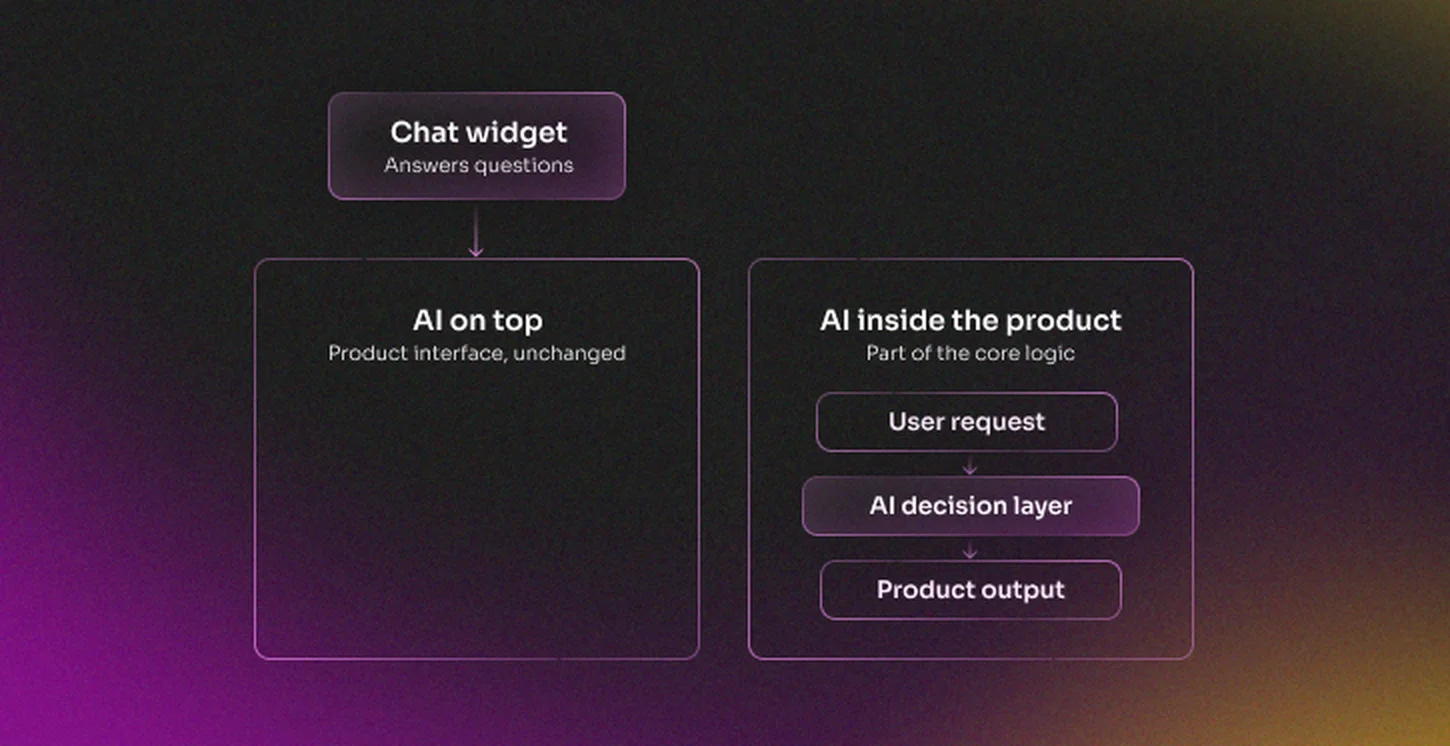
Why AI inside the product differs from AI on top of it
AI product development in 2026 rarely stops at a single chat widget anymore. Most products already ship an AI feature of some kind: a summarize button running on a language model, an autocomplete field, a copilot panel that answers questions about the interface. What most of these features share is where they sit: beside the product's actual decision logic, instead of inside it. The interface changes, while the underlying workflow, the rules deciding what happens next, keeps running on the same logic that shipped before AI arrived.
The five products below take a different approach. In each one, AI sits inside the core product logic, deciding, generating, or explaining something the user could get in no other way:
A real estate platform that scores deals.
A curriculum generator that writes a full lesson plan instead of a paragraph.
An astrology app where a deterministic astronomical engine feeds real planetary positions into a language model instead of letting the model guess.
A healthtech platform where an AI recommendation reaches the patient only after a doctor reviews it.
A clinical app where computer vision replaces a stack of paper stickers.
At Leetio, we worked on all five in different roles: as the engineering team that built the product end to end, as a technical partner extending an existing team, or as the studio behind a founder's personal project. The role changes from project to project. What stays the same is how we get to the first working version: one team across the whole stack instead of handing work between specialists, and a willingness to make product decisions while the spec is still taking shape, which is closer to the norm than the exception on an early AI feature.

Real estate deal intelligence: AI that reads the market for investors
Industry and target user
Real estate investment technology, United States. Built for real estate investors, deal analysts, and operators running flip, buy-and-hold, BRRRR, and wholesale strategies.
The challenge
Finding an investment-worthy property today means manually reading through thousands of listings and public records: tax filings, liens, foreclosure notices, distress signals scattered across sources that stay disconnected from each other. None of this data arrives structured, and none of it explains itself. On top of that, "worth a second look" depends entirely on strategy: a flip investor and a buy-and-hold investor can look at the same listing and reach opposite conclusions. An analyst has to piece together why a specific property fits their particular strategy, and do that at a scale no single person can sustain.
The AI solution
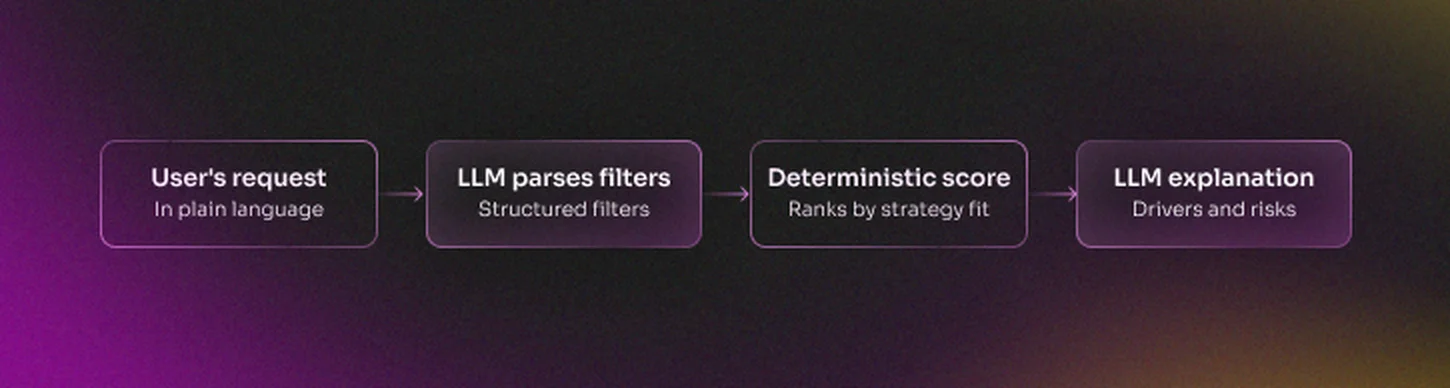
The platform lets a user type a request in plain language, something like "distressed multifamily properties under $400K within twenty minutes of downtown Phoenix." A language model converts that request into structured filters against the platform's own database of enriched property records. Matching properties then go through a deterministic scoring layer, separate from the language model, that ranks them against the user's chosen strategy. Only after scoring does the model step back in, to explain in plain language why a property ranks where it does, what the key drivers are, and what the risks look like.
Splitting the work this way matters. A language model is good at understanding what a user is asking for and at writing a clear explanation afterward. Scoring hundreds of properties consistently against a strategy calls for a different tool, one that stays deterministic and auditable, which also means the ranking stays stable regardless of the model's mood.
Tech stack
A combination of general-purpose LLM providers, with automatic fallback between them for reliability, layered on top of a standard modern web stack (Next.js, PostgreSQL) and a deterministic scoring engine built in-house.
Timeline and team
Leetio joined the project in mid-2026, rebuilding the existing codebase from an earlier vendor. The product reached production roughly two and a half months after Leetio's engineers joined, with a team of two engineers working alongside the client's own product lead and an external designer.
Result
The product moved from manual, source-by-source desk research to a single searchable, scored pipeline where a plain-language question returns a ranked, explained shortlist instead of a spreadsheet full of raw listings.
Curriculum generation for K-12 teachers: AI that builds full lesson plans
Industry and target user
EdTech, K-12 education in the United States. Built for teachers, instructional coaches, and curriculum coordinators.
The challenge
Building a single project-based learning unit by hand takes a teacher hours: aligning it to the right standards (Common Core, NGSS, or a specific state framework), designing activities that fit the timeline, writing assessments, and pulling together materials. A generic AI chat produces a paragraph of ideas in seconds, while a usable curriculum plan needs to be a complete structured document instead of a block of freeform text.
The AI solution
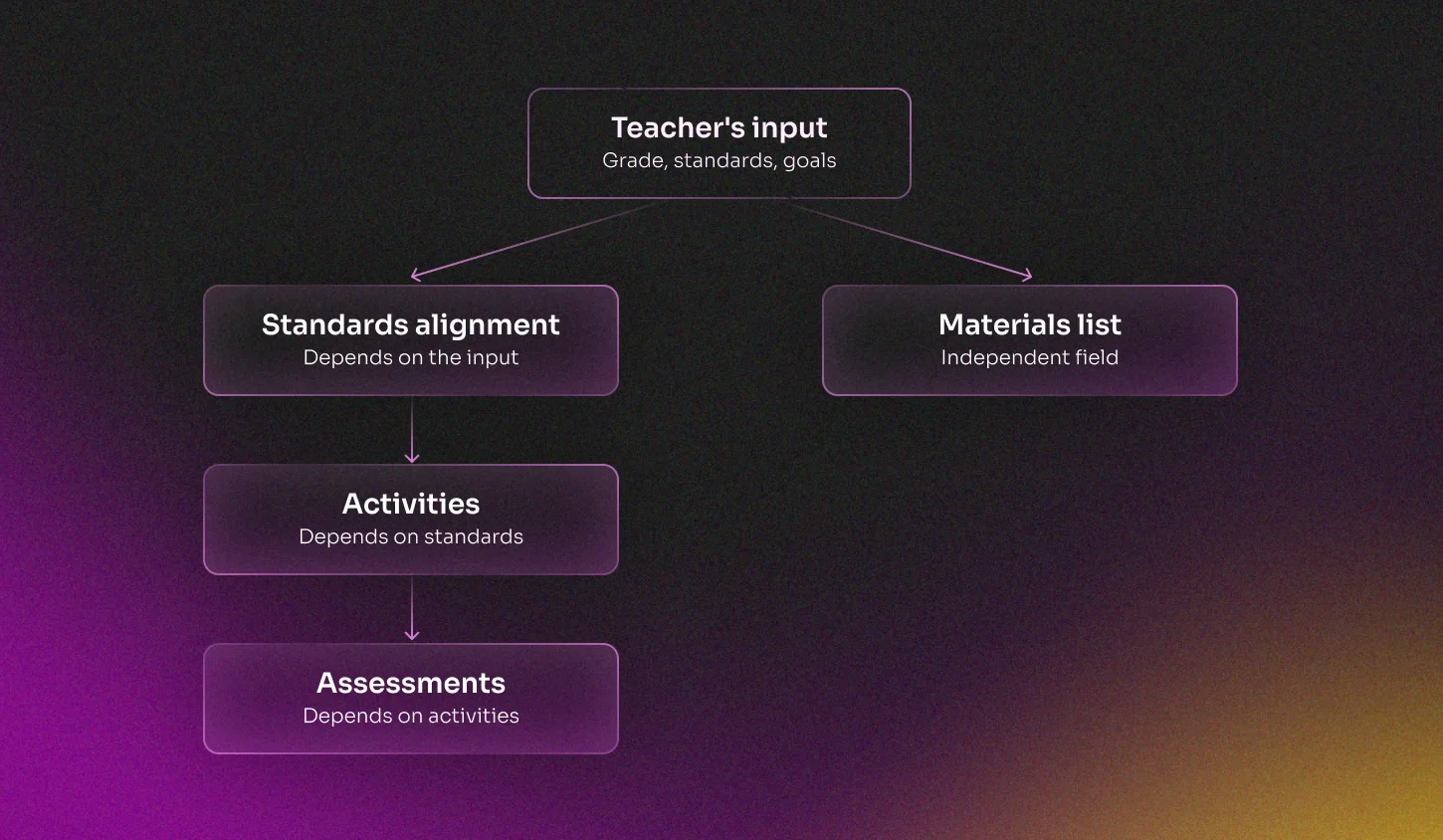
The product asks a teacher for the basics, the grade, subject, duration, and learning goals, along with the specific standards to align to, and lets them optionally upload existing materials for extra context. From there, generation runs as a sequence: the system maps out which parts of the plan depend on others and generates them in the right order, while independent sections generate in parallel to keep the process fast. Every output goes through schema validation before it reaches the teacher, so the result stays a complete, structured plan instead of a loose collection of text.
One detail matters for anyone building something similar: when a teacher edits part of a generated plan, the system evaluates what changed and regenerates only the dependent parts, leaving the rest untouched. This keeps iteration fast and keeps a teacher's own edits from disappearing silently.
Tech stack
A general-purpose LLM provider accessed through a standard AI orchestration layer, combined with embeddings for retrieval over the materials a teacher uploads, and a dedicated observability layer for tracking prompt performance in production.
Timeline and team
The project started in February 2026, with Leetio joining in June 2026. The product runs live in a closed pilot, with one engineer from Leetio working alongside an engineer on the client's side and an external design partner.
Result
The pilot keeps gathering feedback from real classroom teachers instead of publishing hard numbers, while the core outcome already holds: a process that used to take hours of manual standards alignment now produces a complete, schema-validated plan a teacher can review and adjust in minutes.
Zoria: AI astrology grounded in real astronomical data
Industry and target user
Astrology and consumer wellness, live across Ukraine, Poland, and English-speaking markets. Built for people who want a personalized reading instead of the same generic horoscope everyone else gets.
The challenge
Most horoscope apps generate the same generic content for everyone born under a given sign. A real, personalized reading has traditionally required a human astrologer, which stays hard to scale and awkward to fit into a subscription price point. The challenge was building AI-generated readings that are actually grounded in real astronomical positions, work in three languages, and still keep unit economics that make sense for a consumer app.
The AI solution
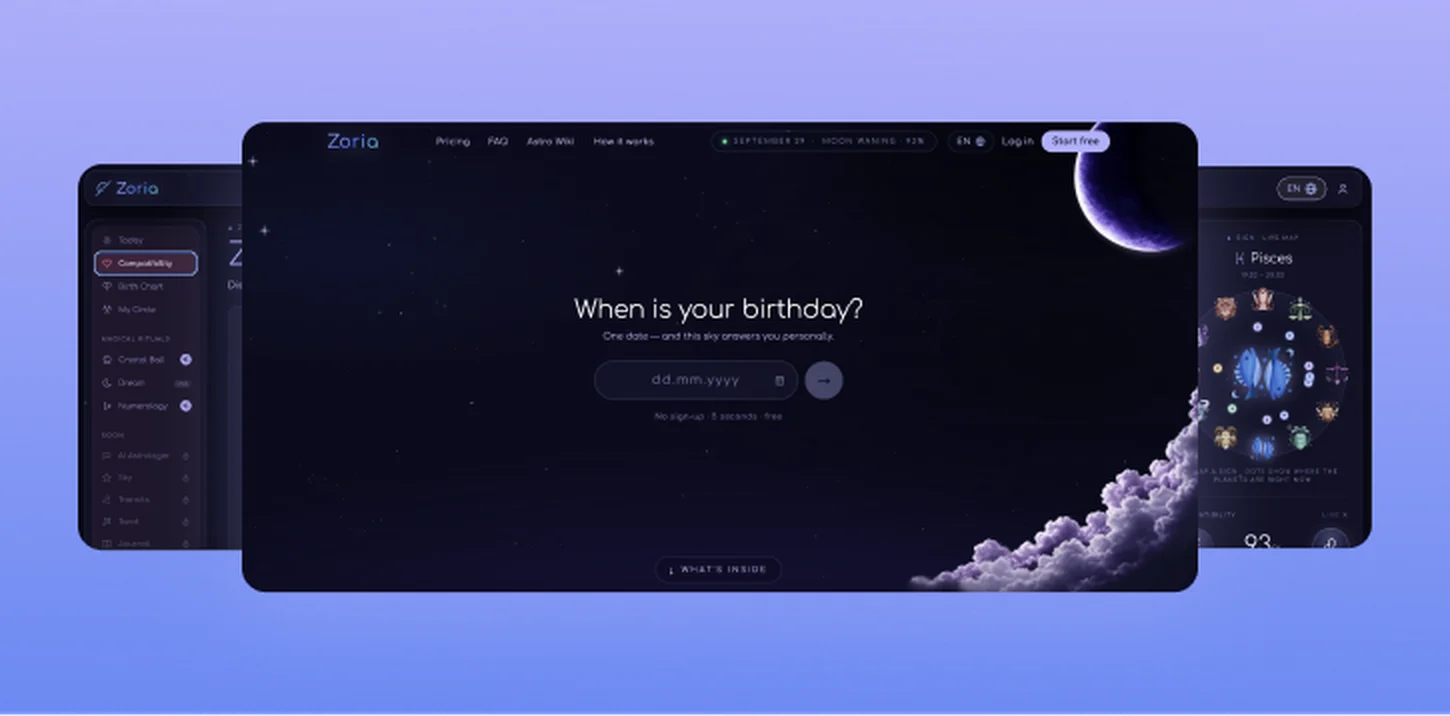
Zoria runs 14 separate AI features, from daily horoscopes to natal chart breakdowns, dream interpretation, compatibility readings, numerology, and a live streaming chat with an AI astrologer. What keeps the output grounded is a layer the language model never touches: planetary positions, moon phases, and retrograde periods are all calculated in code, using an astronomy engine, before anything reaches the model. The AI's job is to turn a set of already-correct facts into a readable, personal interpretation, leaving the guessing about the sky to the astronomy engine instead.
Tech stack
Anthropic's Claude (Haiku 4.5) powers all 14 AI features, with prompt caching and a batch processing API for high-volume generation, plus streaming for the live chat feature. The backend runs on NestJS with PostgreSQL, Redis, and BullMQ, the frontend on Qwik with server-side rendering, and the app supports English, Ukrainian, and Polish with content generated natively in each language instead of machine-translated afterward.
Timeline and team
The first version launched in the summer of 2025. A full rebuild shipped in April 2026 and stands as the current live version, built and maintained by a team of three.
Result
Running 14 AI features across three languages costs between $0.03 and $0.06 per user session, a direct result of using a smaller, faster model with prompt caching instead of defaulting to the largest available LLM for every request.
Chirayou: AI biomarker analysis for preventive health
Industry and target user
Healthtech, Germany. Built for users tracking long-term preventive health, with a dedicated workspace for the doctors reviewing their data.
The challenge
The founder came to Leetio with a clinical team, a lab partnership, and a working backend prototype, alongside zero user-facing product: no mobile app, no doctor portal, no AI pipeline turning lab results into something a person could actually act on.
The AI solution
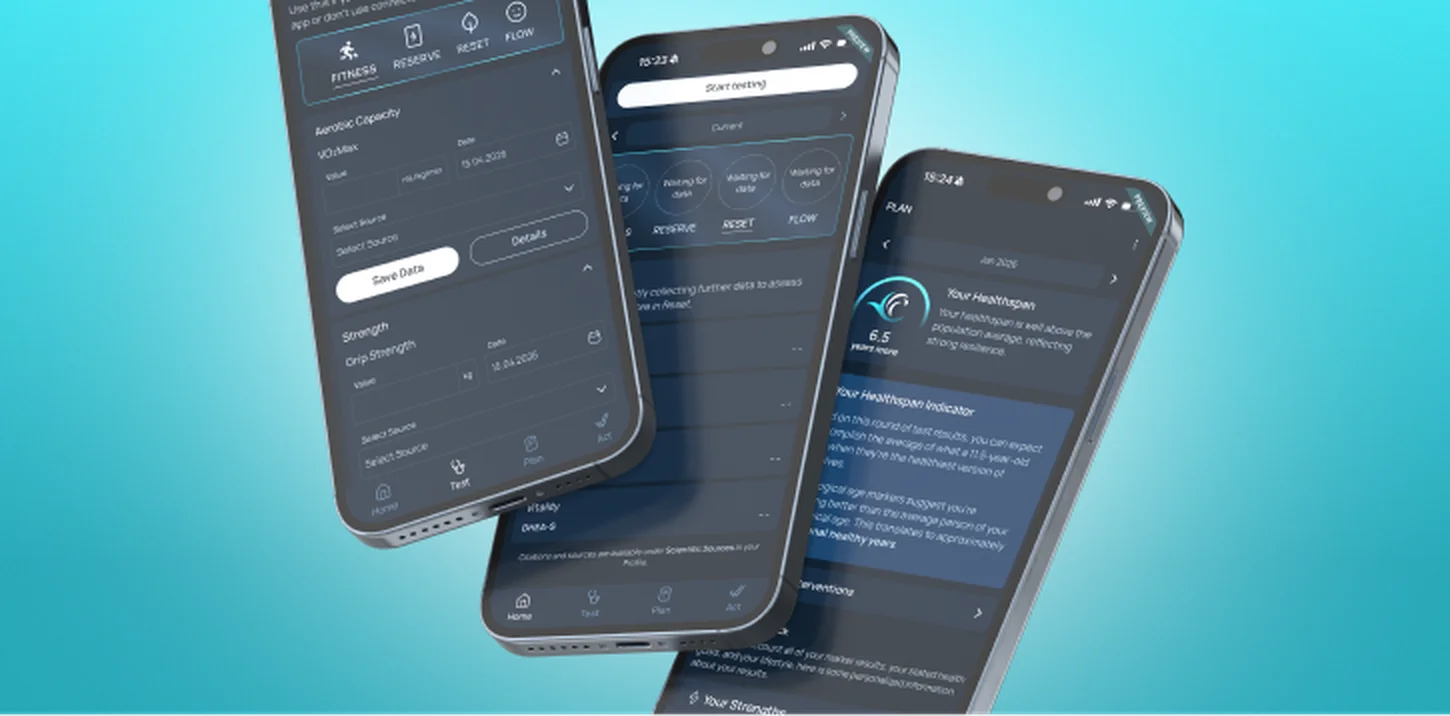
Chirayou's core AI pipeline runs on Google Gemini, analyzing more than 20 biomarkers across four health categories and combining them with medical history, family risk, and wearable data into a single healthspan score, along with ten priority actions for that specific cycle. Every AI-generated report reaches a user only after a licensed doctor reviews it, which is the detail that makes the whole pipeline usable in a regulated industry, past being a purely technical showcase.
Result
Two engineers delivered the full mobile app, doctor and admin portals, and AI pipeline in 11 months. The platform has run more than 150 doctor consultations since launch, normalizing data from five different medical sources and localizing AI-generated medical content into multiple languages along the way.

SnapLog: AI text recognition for clinical data
Industry and target user
Healthcare, Australia. Built for surgeons and clinical staff working in operating theaters, where every extra minute matters.
The challenge
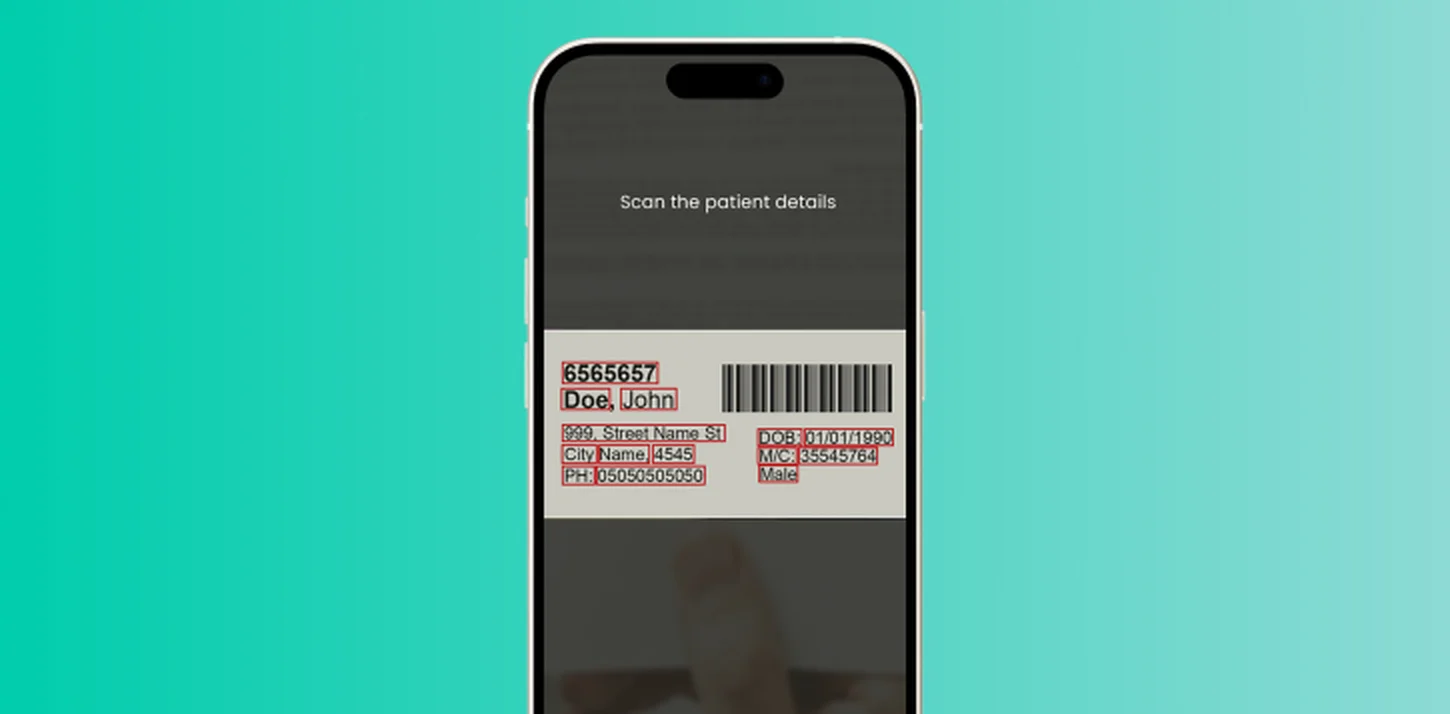
Manual documentation in an operating room, sticky notes on patients, updates typed into a spreadsheet between cases, grows unreliable under pressure and resists scale. The task Leetio's team isolated stayed narrow on purpose: transcribing structured clinical data from handwritten or printed labels, a high-frequency, predictable task with no subjective judgment involved, which made it a strong first candidate for automation.
The AI solution
SnapLog uses AI-driven text recognition to scan patient and operation details and make that data usable within roughly three seconds. The first version ran on Google's OCR technology, and the team followed it with a custom Python-based model trained specifically for this kind of medical documentation, with ongoing learning planned for later phases. If the recognized data has low confidence, it gets flagged for a quick manual check instead of silently going through, which keeps the app usable even when the model gets something wrong.
Result
A three-second scan-to-data pipeline built by a team of three engineers, one PM, and one QA over six months, running on AWS with React Native on mobile and a Laravel and React admin panel on the web, with web and native development structured to run in parallel.

What these 5 products have in common
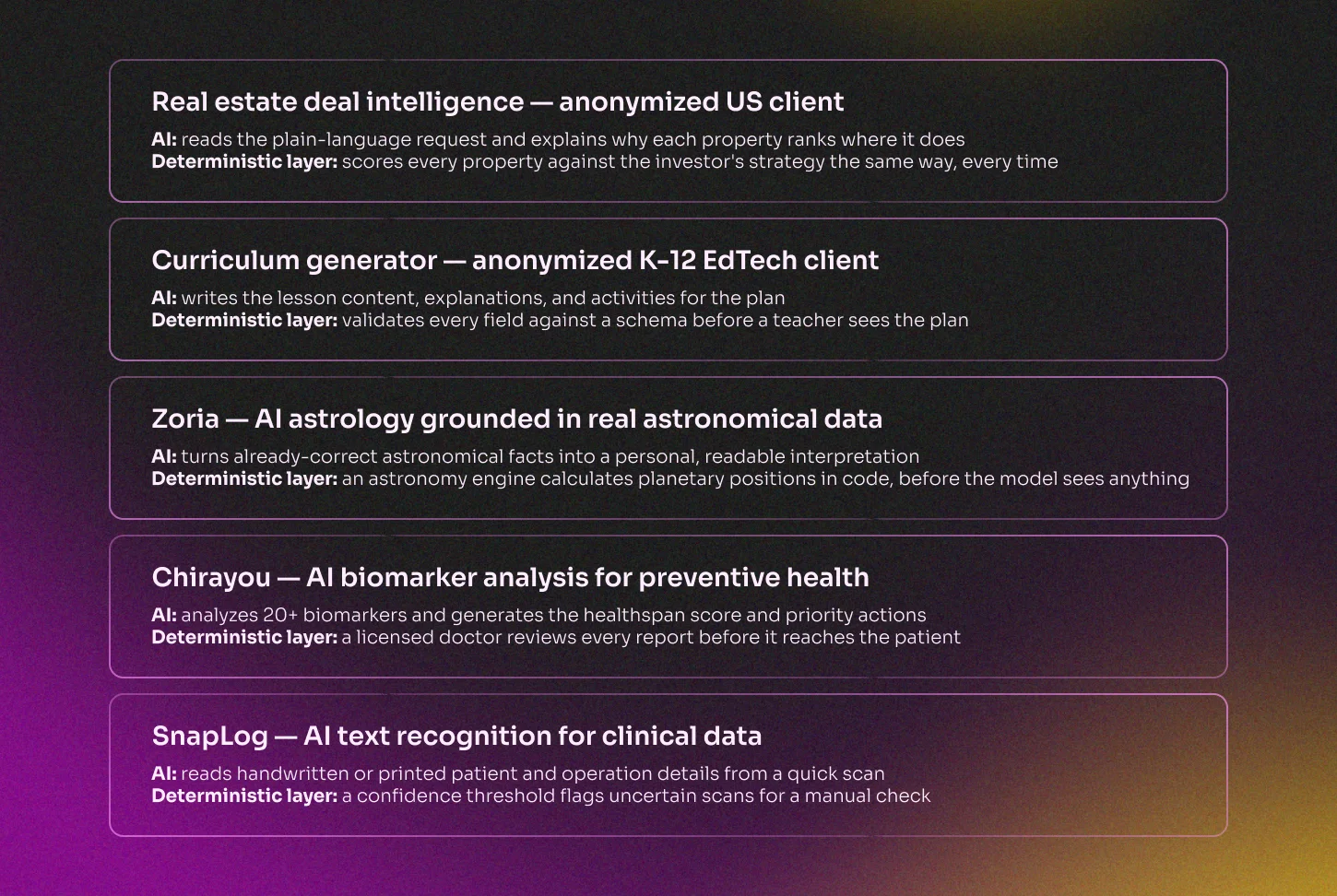
These five products span five different industries and five different reasons to use AI, but they share one common pattern: none of these teams handed an entire workflow over to a language model and called it done. Every product pairs the model with something deterministic, a scoring engine, a schema validator, an astronomical calculation layer, a doctor's review, a confidence threshold, and lets the model do the part it is actually good at: understanding language and producing a readable explanation, while a separate layer stays the single source of truth for a decision that matters.
This pattern reflects a deliberate discipline, the same one Leetio applies on the engineering side of every AI integration: define exactly where a model adds value, decide what stays deterministic, and build a fallback for when the model gets it wrong. That process is covered in more detail in our earlier piece on AI integration in digital products.
Final Thoughts
Five industries, five different reasons to reach for AI, and five different answers for where to draw the line between the model and the rest of the system. The real estate platform keeps scoring deterministic and lets the model handle language. The curriculum generator validates every output against a schema before a teacher sees it. Zoria calculates the sky in code and lets the model interpret it. Chirayou routes every AI-generated health report through a licensed doctor before it reaches a patient. SnapLog flags low-confidence scans for a human instead of guessing.
None of these teams treated AI as a single ingredient dropped into an existing product. Each one started with a specific point in the workflow, an analyst piecing together public records, a teacher building a plan by hand, a user who wants a real reading grounded in real astronomy, a doctor who needs a defensible recommendation, a surgeon documenting a case between procedures, and built the model and its guardrails around that exact point.
This is the same discipline behind every AI feature Leetio ships: identify where a language model adds real value, decide what stays deterministic, and design the fallback before the feature goes live. It holds for an early-stage real estate startup and for a live healthtech platform operating under audit and clinical sign-off requirements, at every stage in between.
If a product needs an AI feature built this way, with a real workflow behind it and a plan for when the model gets something wrong, Leetio's engineering team can scope the feature, choose the model and architecture, and take it into production.
FAQ
- AI on top of a product is usually a chat widget or assistant added next to an interface that otherwise works the same way it always did. AI inside the product means the model is part of the core logic, generating a plan, scoring an option, or explaining a decision that depends entirely on it.
- Most of the products in this article run on off-the-shelf models like Claude or GPT, paired with deterministic logic around them. A custom-trained model only made sense in SnapLog, where the specific accuracy requirements of medical text recognition justified the extra investment.
- It depends more on the complexity of the surrounding logic than on the AI call itself. Chirayou's full AI pipeline, alongside a mobile app and two web portals, shipped in 11 months with two engineers. A narrower feature can move faster once the product's data is already structured.
- Consistency and auditability. A deterministic scoring or calculation layer produces the same result for the same input every time, which matters when the output affects a financial decision, a medical recommendation, or an astronomical fact. The AI layer then focuses on language, leaving the source-of-truth duty to the deterministic layer.
- The first conversation centers on the workflow instead of the model: what point in the product causes friction, where a person loses time, or where a decision takes too long. From there, Leetio's team maps that friction point to a type of AI task, generation, scoring, classification, or extraction, picks a model that fits the accuracy and cost profile, and builds a small prototype inside the real product flow before committing to a larger build.
- AI adds the most value at points where a person previously combed through large amounts of unstructured data to make one decision, wrote the same type of document over and over, or explained something in plain language that a system already calculated correctly. The five products above cover all three: scoring distressed properties, generating full lesson plans, and translating real astronomical data into a personal reading.