The model is the smallest part: How we automate business operations with AI

Where AI workflow automation breaks in practice
AI workflow automation usually starts with a quick win: Someone pastes a few rows into a chat model, gets good answers, and decides to run the whole process through it. Ten rows work fine. Ten thousand rows expose everything around the model: responses a program fails to parse, jobs that hang, API limits, duplicate emails, and lost replies. Gartner expects over 40% of agentic AI projects to be canceled by the end of 2027, pointing to rising costs, unclear business value, and weak risk controls.
In the first article of this series, we looked at AI built into product logic. This one moves to the operations behind a product: the repetitive work of sales, reporting, meetings and support. Below are four automation projects our engineers built. In each one, the model handles one narrow step. Code, rules and people handle everything else, and that split is what made each project hold up in daily use.
A single model call is the easy part. In operations, the same step repeats hundreds or thousands of times a day, feeds other systems and sometimes reaches people outside the company. Across the projects below, three pressure points came up again and again:
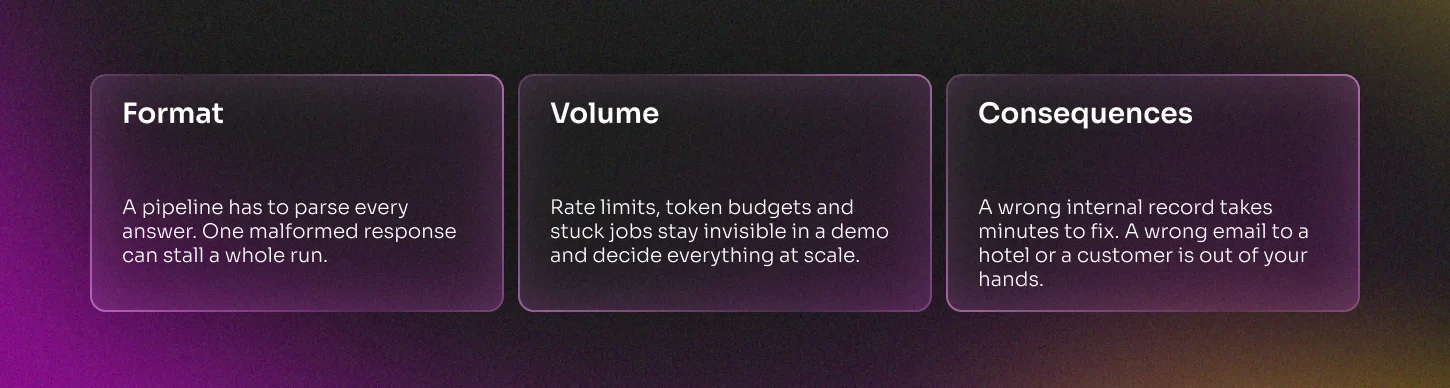
Format. A person reads a model's answer. A pipeline has to parse it, every single time, and one malformed response can stall a whole run.
Volume. Rate limits, token budgets and stuck jobs stay invisible in a demo and decide everything at scale.
Consequences. A wrong record in an internal system costs a few minutes to fix. A wrong email to a hotel or a customer is out of your hands the moment it leaves.
Each case below shows how the team handled these three points, and where the line between AI, code and people ended up.
B2B lead generation platform: From stalled batches to 160 leads a minute
Industry and target user. Sales and B2B lead generation. Built for SDRs, sales teams and marketers who need to build and filter a list of potential clients for a specific buyer persona.
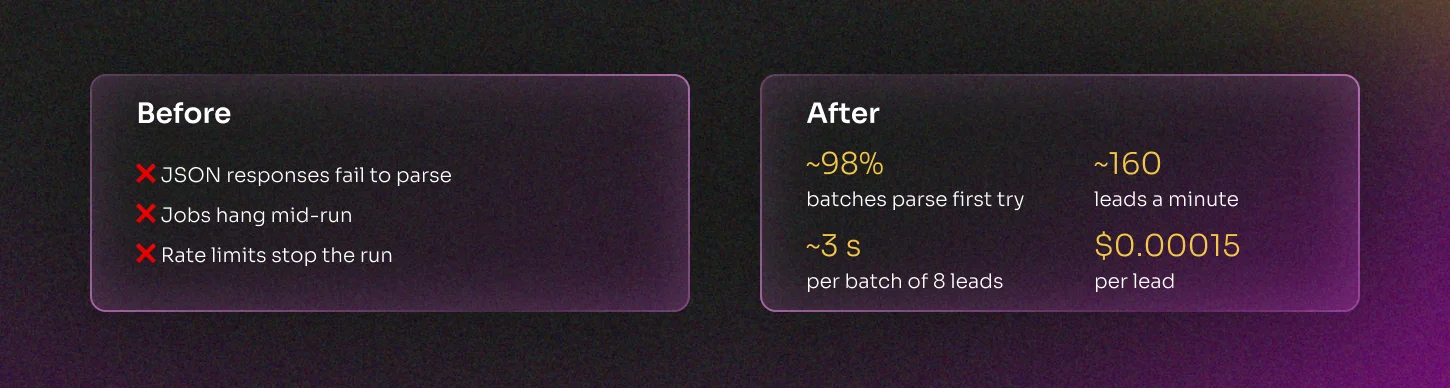
The challenge. Lead research used to be manual. People googled profiles and companies, read each profile, decided "fit or no fit" and only then passed the list on to enrichment and outreach. Qualification was the bottleneck: A search returns thousands of raw candidates, only a minority of them relevant, and a person has no way to give each one the same attention. When we joined, the client already had a working prototype. At real volumes, its qualification step broke down: Model responses failed to parse, jobs hung mid-run and API rate limits stopped processing altogether.
The AI solution. The platform runs a fixed funnel: persona → candidate collection → AI validation → enrichment → final list, exported to CSV or XLSX. The user describes the target client in plain words, and GPT-5 mini turns that description into structured persona criteria. For lead scoring, Claude 3 Haiku then evaluates each candidate against the persona at a low temperature and returns a score from 0 to 100, a written reasoning, the list of criteria that matched and a high, medium or low category. OpenAI embeddings add a separate similarity score between the lead and the persona.
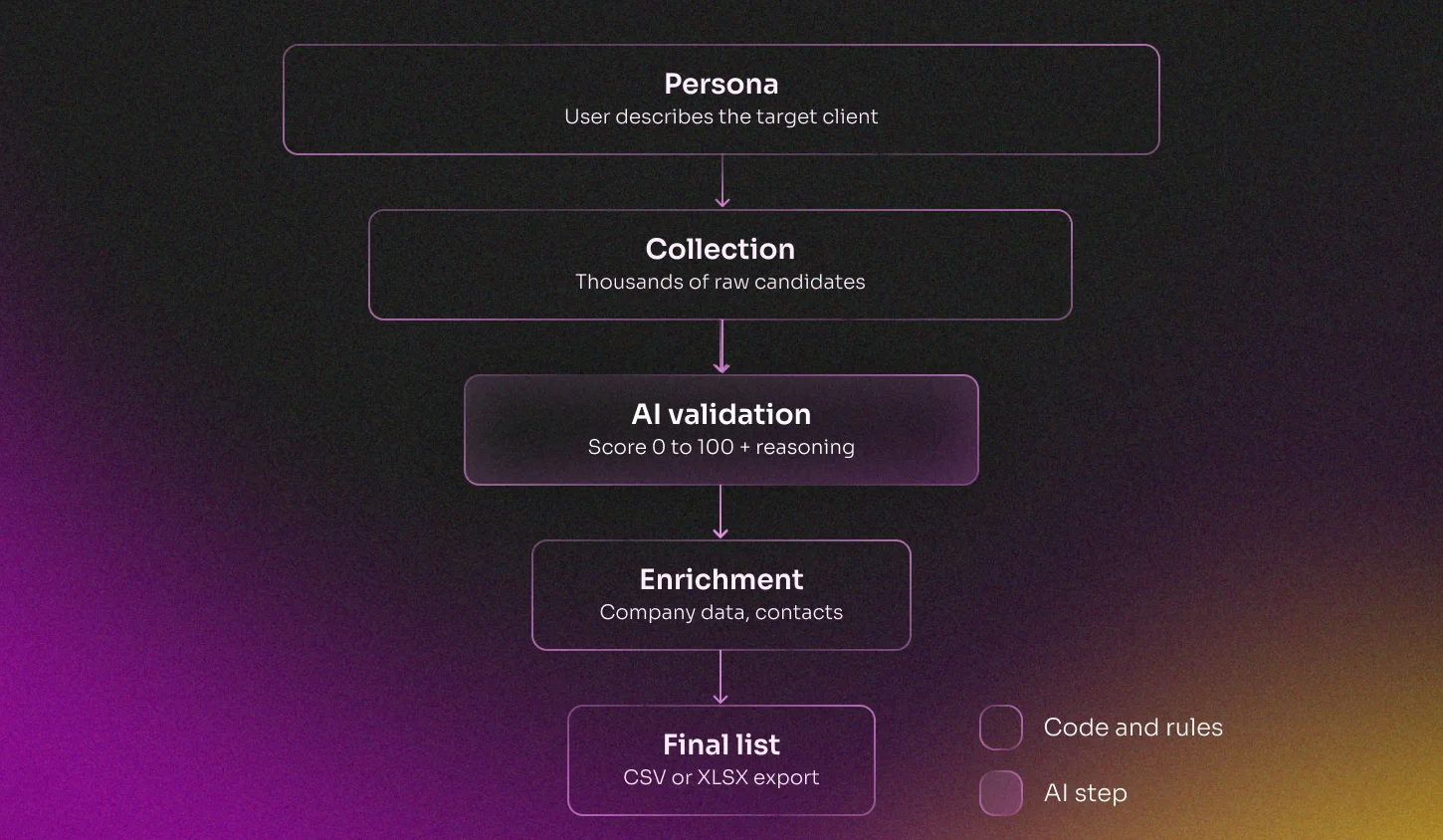
That is the full extent of the AI's job: It evaluates and explains. Everything else is code and rules:
Candidate collection through search APIs;
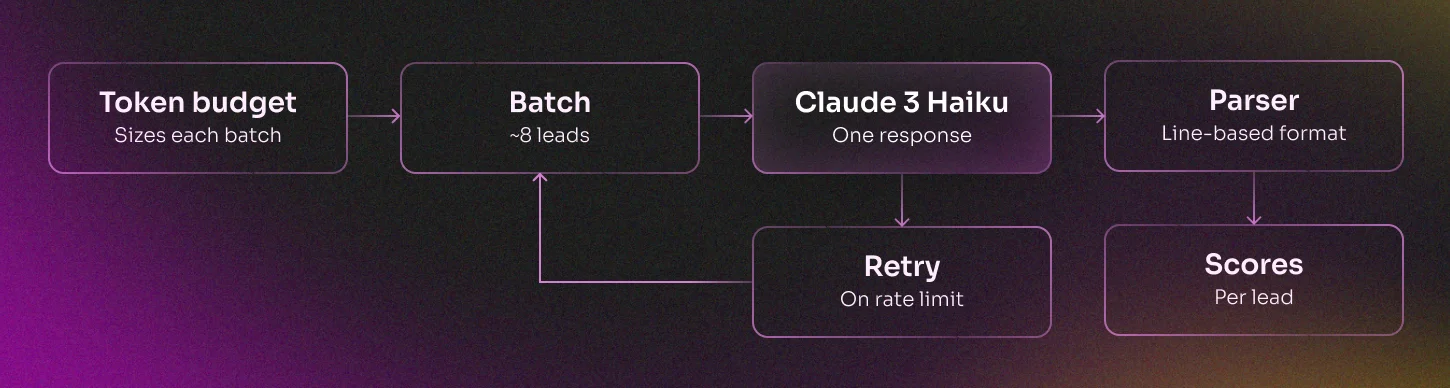
A job queue with batch processing sized to a token budget, around 8 leads per model call;
Response parsing, with a simple line-based answer format in place of JSON, which now parses on the first try in about 98% of batches;
Retries on rate limits and automatic recovery of stuck jobs;
Score thresholds that decide which leads move on to enrichment, plus deduplication.
People stay in control of every decision that matters for sales. They create the persona, launch validation, review the scores together with the reasoning, approve or reject leads and choose who goes to enrichment and outreach. Prompts live in the database and can be edited from the admin panel, so the team tunes them with no new release.

Tech stack. AI: Anthropic Claude 3 Haiku for lead validation, OpenAI GPT-4o and GPT-4.1 as switchable alternatives, GPT-5 mini for persona generation, OpenAI text-embedding-3-small for similarity scoring. Product: React, TypeScript, Vite, shadcn/ui, Tailwind, TanStack Query, Supabase (Postgres, Auth with roles, Realtime, Edge Functions on Deno), Render for frontend hosting, Clay webhooks for company and contact enrichment. The first prototype was built in Lovable.
Timeline and team. The client's founder started the prototype in August 2025. Leetio joined at the end of September 2025, the main engineering work ran through October, and the last iteration shipped in early November 2025. The team: one Leetio engineer and the client's founder acting as product owner.
Result. The AI lead qualification pipeline now runs end to end in a pilot, from persona to an enriched list ready for outreach. About 98% of batches parse on the first try, and the remaining 2% go through an automatic retry. One batch of 8 leads takes around 3 seconds, which adds up to about 160 leads a minute, so lists of thousands of candidates get processed in minutes. At roughly 4,500 tokens per batch, validation costs about $0.00015 per lead on Claude 3 Haiku.
Training analytics bot: Progress reports with zero screenshots
Industry and target user. Sportstech and endurance training analytics. Built for an amateur triathlete preparing for a long-distance race, with months of Garmin data and little time to read it. The same setup could serve coaches who work with several athletes.
The challenge. Every session needed a manual review: Open Garmin Connect, copy the metrics or screenshot them into a Claude chat, find similar workouts from a few weeks back and decide if the change was progress or noise. That took 20 to 40 minutes per session, at 8 to 10 sessions a week, and it worked only when the athlete remembered what to compare against. The biggest loss was long trends. A single session can look fine while aerobic efficiency slowly drops or the heart rate keeps going over the ceiling set by the coach. That pattern shows up only across 5 to 8 workouts, and nobody tracked it by hand.
The AI solution. After every workout, a Telegram bot pulls the session from Garmin Connect, stores it in a local database and sends it to Claude for analysis. The athlete gets a review in place of raw numbers: what changed against earlier sessions of the same type, which metrics are improving, where the workout drifted from the plan, and the priority for the next session. The bot also flags deviations, for example a heart rate above the 138 bpm ceiling set by the coach. In one cycling report, the model noticed that two rides at 31.6°C and 32°C showed a higher heart rate at lower power, estimated that the heat was adding 4 to 6 beats, and recommended capping the heart rate at 130 bpm in the next session. A separate /report command builds a summary for each discipline: Code puts together the metric table with a trend marker for every metric, and Claude writes the analysis below it.
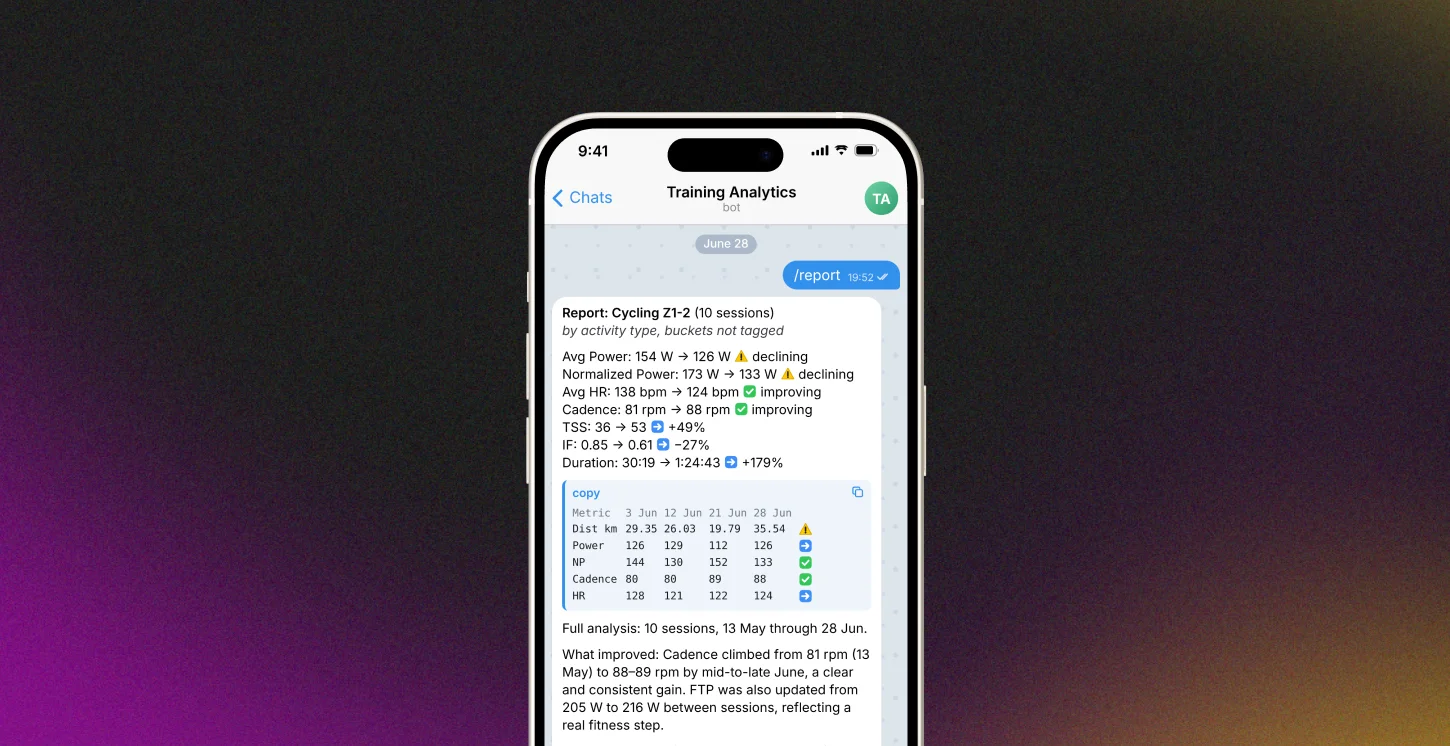
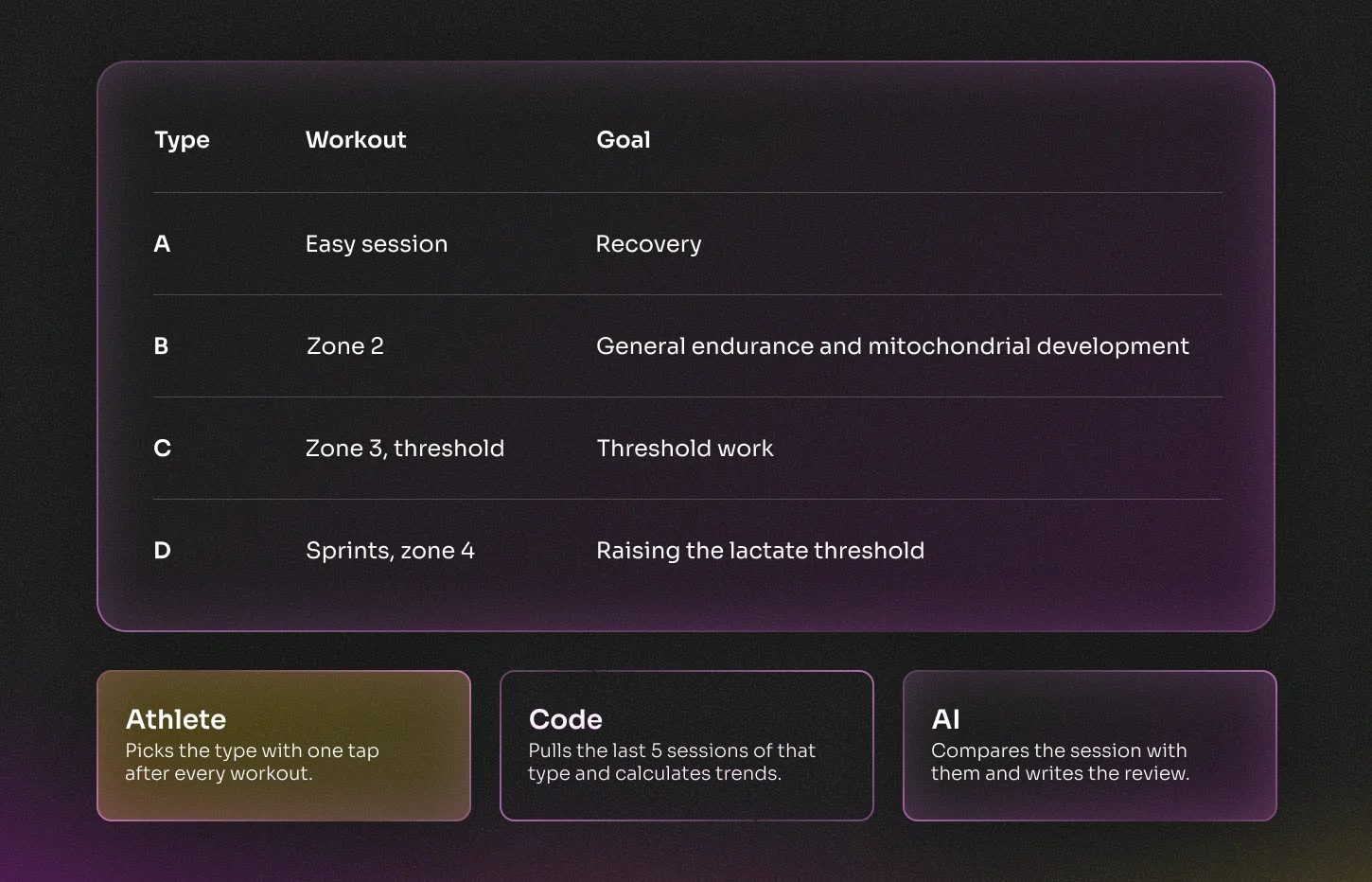
The context for the model is assembled by code: For every new session, the bot pulls the last 5 sessions of the same confirmed type from SQLite. This is structured retrieval from the bot's own database, with no vector search involved.
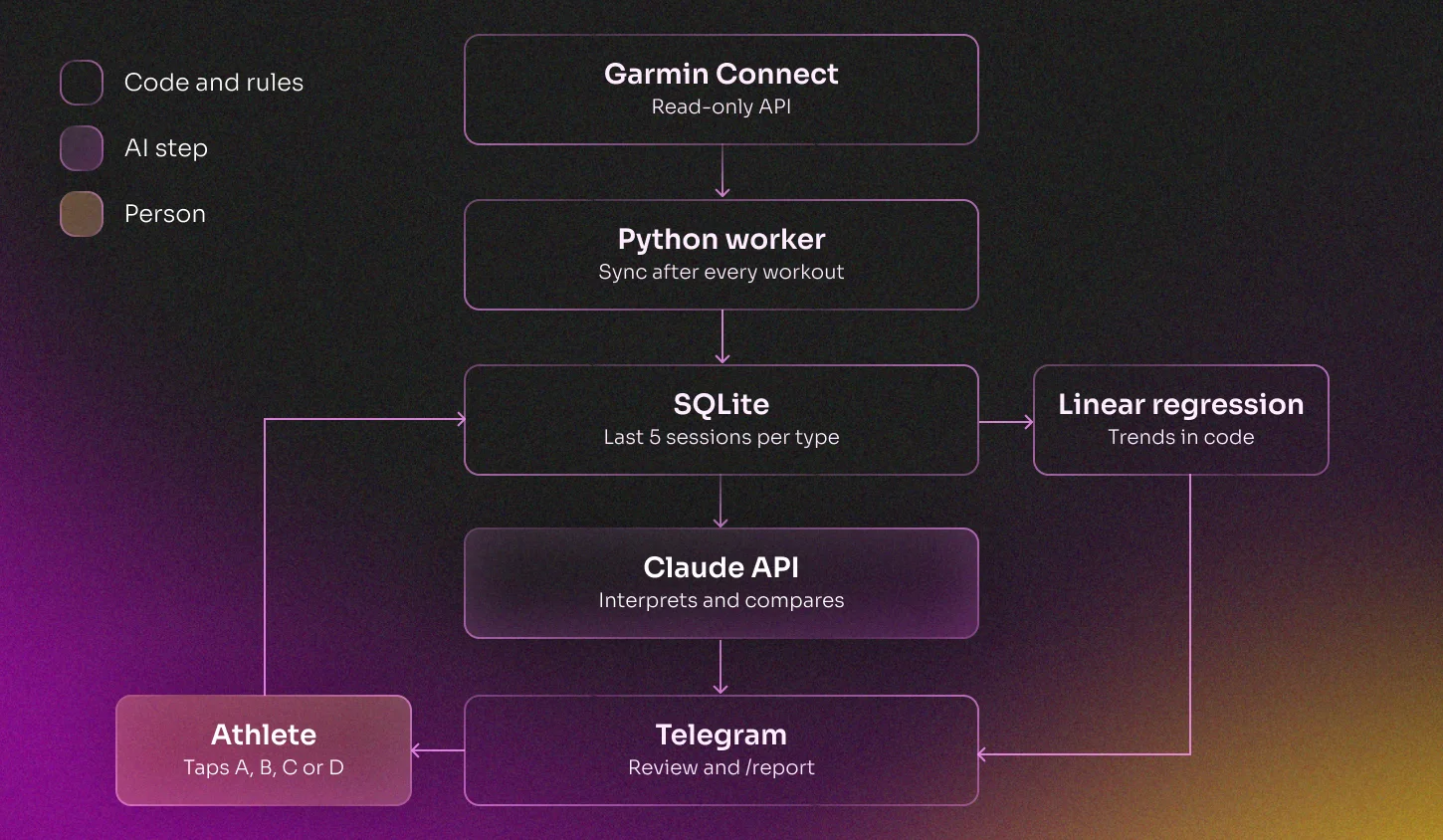
The split between AI, code and the athlete is strict:
AI interprets the session, compares it with earlier ones and writes the conclusion and the next priority;
code handles authorization and data pulls from Garmin, storage, table building and delivery to Telegram, and it calculates trends with linear regression, so the numbers stay reproducible and never depend on the model;
the athlete confirms the workout type with one tap on an A, B, C or D button (easy recovery, zone 2 endurance, zone 3 threshold or zone 4 sprints), because the intent behind a session matters more than what the heart rate suggests, and decides which sessions go into reports. Garmin Connect remains the source of truth for zones and charts.
Tech stack. AI: Anthropic Claude API (Sonnet), with prompts tuned to the training taxonomy and structured context from the bot's own database. Product: Python, python-telegram-bot (inline and persistent keyboards), python-garminconnect with read-only access to Garmin Connect, SQLite and a macOS LaunchAgent. The code was written in Claude Code.
Timeline and team. Work started in early July 2026. Going from an empty folder to a full Telegram → Garmin → database → Claude → Telegram cycle took a few days of iterative work. The team: one person, with an AI coding agent writing the code.
Result. The manual review loop is gone: After every workout, the analysis arrives in Telegram with the comparison already done, and long-term trends that nobody tracked by hand now show up in every /report. The bot works as a proof of concept: Sync, classification, analysis, reports, history backfill and session exclusion are all live. For now it runs on a laptop, with no permanent hosting yet.
Tiho: Ready-to-say answers on a call, with audio that stays on the Mac
Industry and target user. Productivity and meeting intelligence. Built for founders, consultants, team leads and project managers with 3 to 10 calls a day, who need exact answers from their own documents in the language of the call.
The challenge. On a call, the answer usually sits somewhere in a document: a proposal, a price list, a spec. Finding it means pausing the conversation or promising to follow up later, and a misquoted figure is hard to take back. After the call, notes were either skipped or typed by hand, and decisions got lost along the way. Cloud meeting tools cover part of this at the price of sending call audio to someone else's servers, and they often give weaker quality on Ukrainian and Russian.
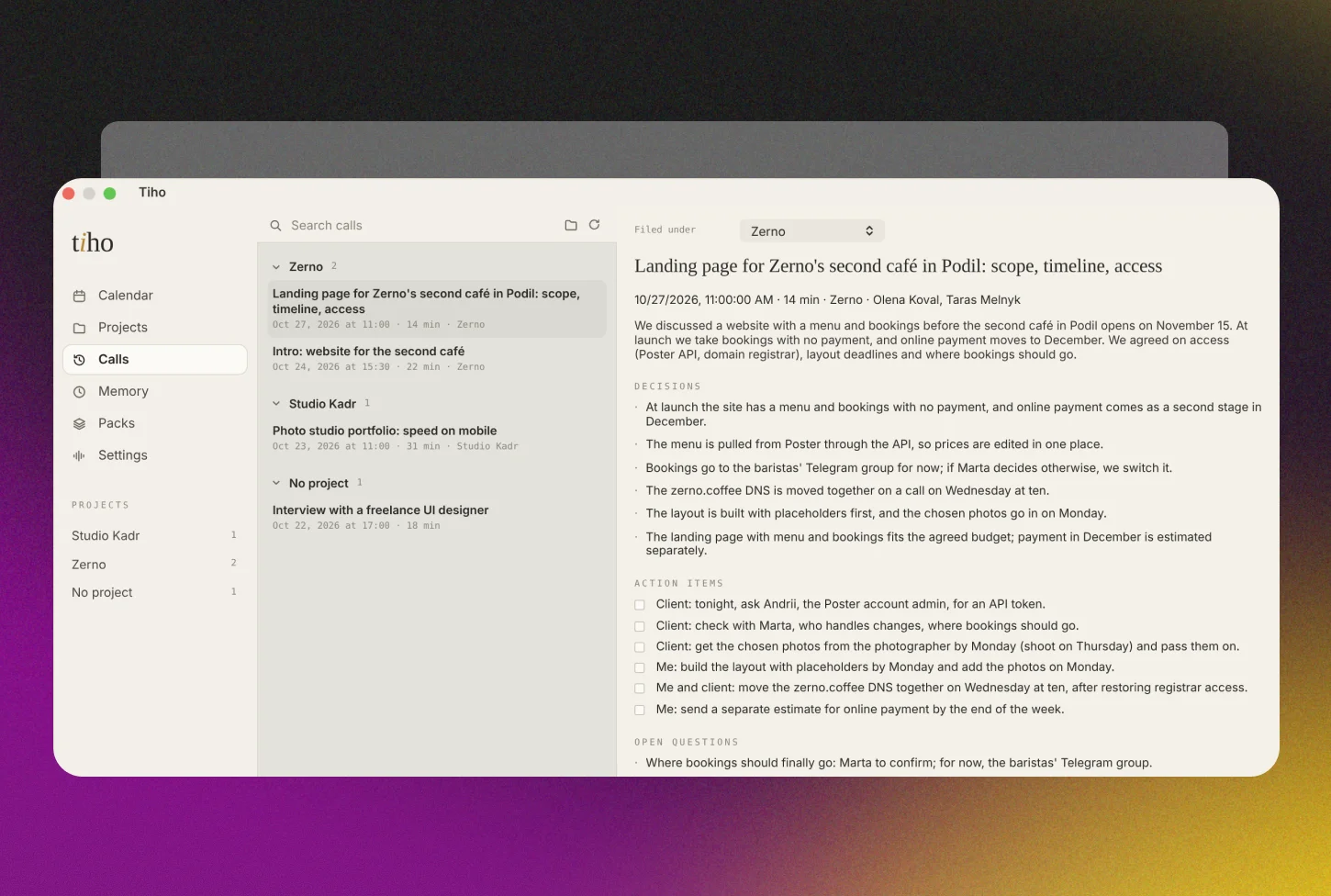
The AI solution. Tiho is a native macOS app that brings two internal tools together: Echo, which filed call notes with no manual steps, and Sufler, a live prompter for calls. Before a call, the user can prepare a pack of their own files for context. During the call, one hotkey brings up a quick, ready-to-say answer in about a second, and Shift with the same hotkey gives a fuller briefing in two to three seconds. Answers come from the pack and from past calls. Every answer shows the question Tiho heard and the exact source, file and page, and it comes in the language of the call, with 14 languages supported. If the files hold no answer, Tiho says so, and it flags misquoted numbers with the correct figure. For calls where a panel on screen is a bad idea, the panel stays hidden and answers go quietly to Telegram.
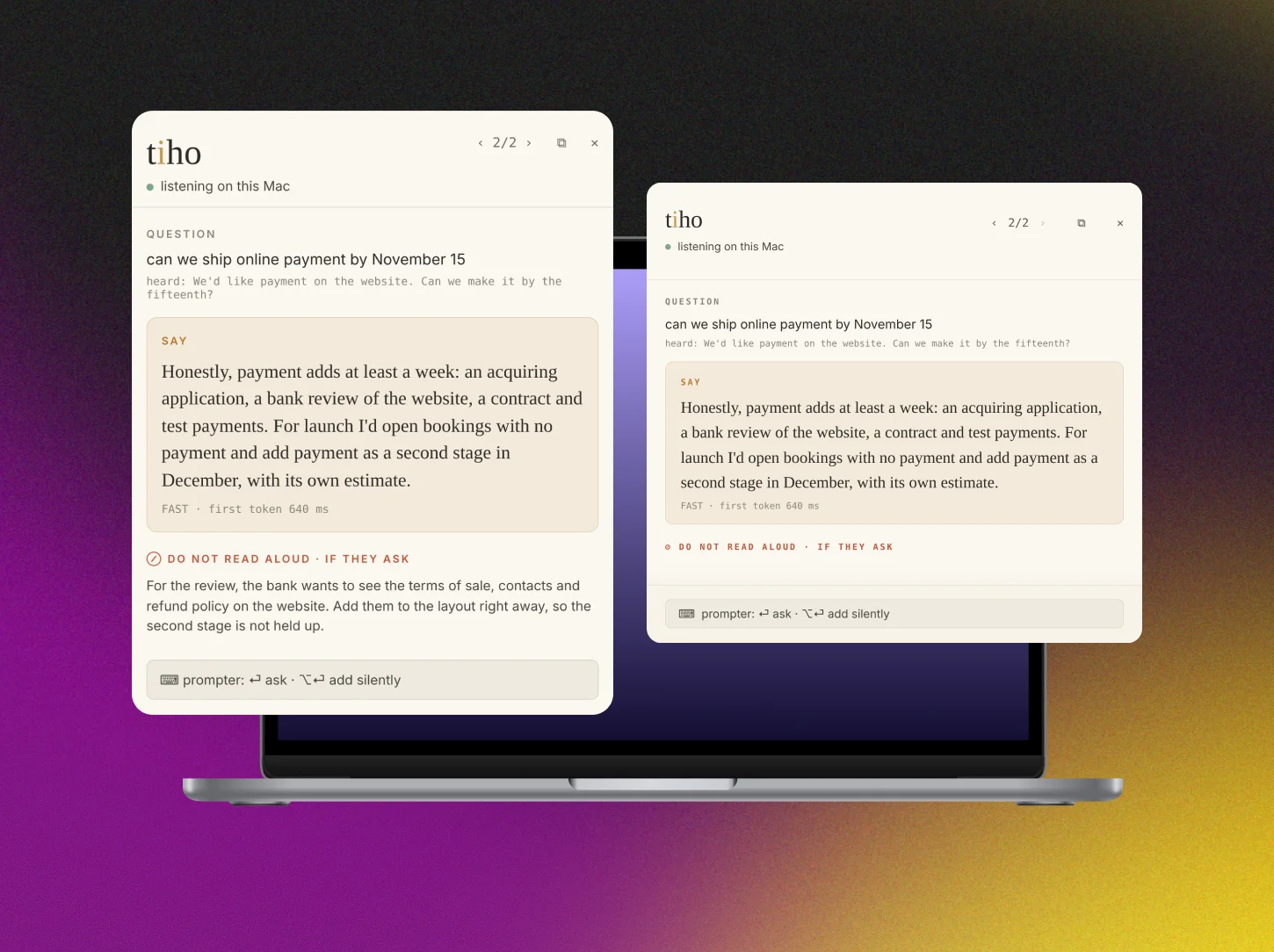
After the call, Tiho files the recording, the transcript and a summary in its own call log, names the participants from the calendar and links the call to a project. The next call with the same client starts with that client's history. For teams that keep notes in Notion, the Notion integration remains as an option.
AI does two jobs here. whisper.cpp with the large-v3 model transcribes the audio locally on Apple Silicon. Claude then receives only text, answers from the user's own materials and writes the call summary.
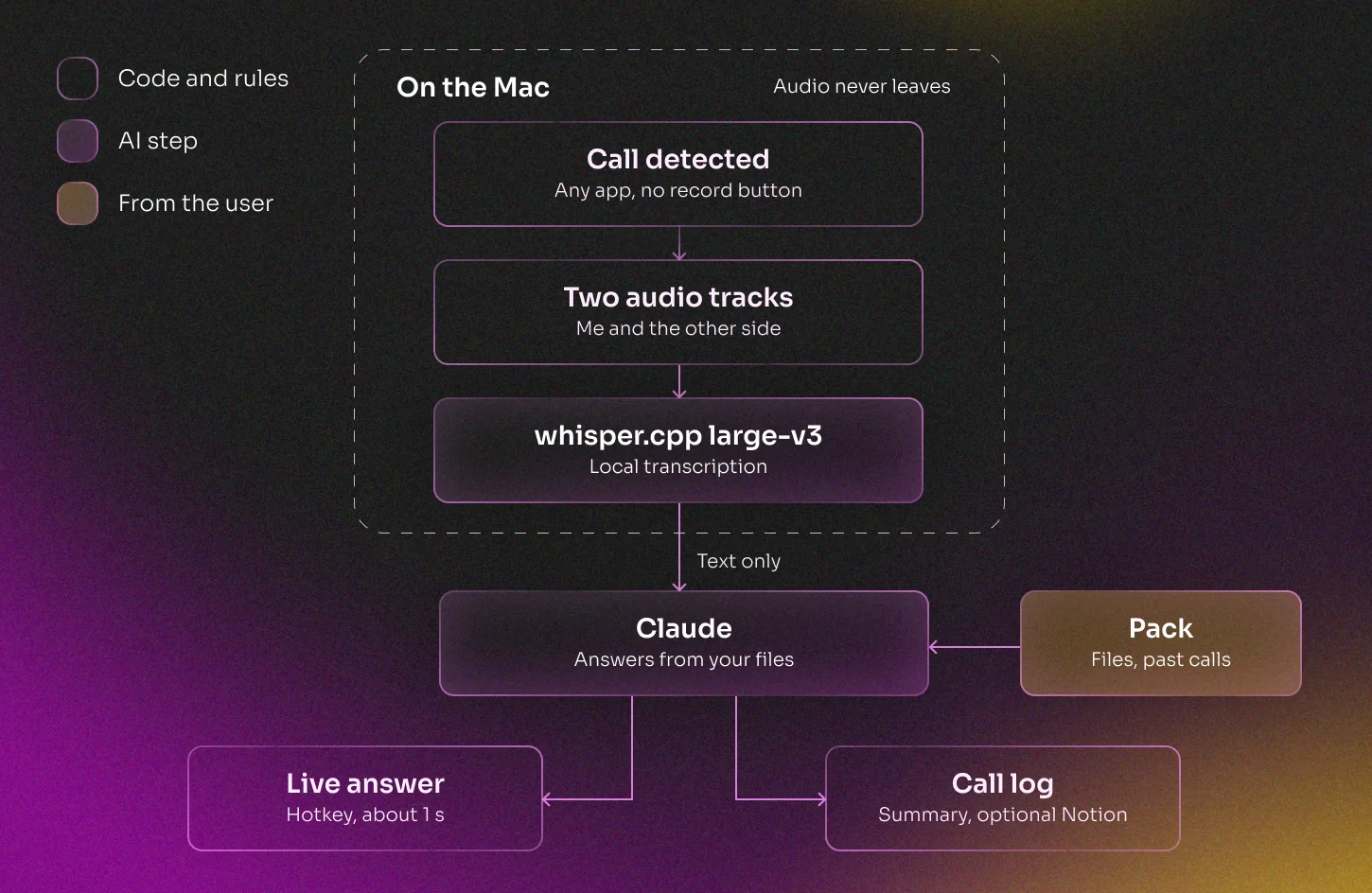
Code handles everything around those two steps:
detecting the start and end of a call from the audio streams of running apps, resuming a dropped call into the same note, splitting back-to-back meetings and skipping empty recordings;
recording two separate tracks ("me" and "the other side") and labeling speakers from the tracks themselves, with no diarization model involved;
reading the meeting title and participants from the calendar;
showing the real token count of every answer and a running daily total.

Two hard rules live in the product. Audio never leaves the Mac, and a user can check that with a network monitor. Answers come only from the user's own materials and past calls. The person stays in charge of everything that matters on a call: when to ask, what to say aloud and how to get consent. Before the first call, Tiho asks the user to confirm they will get everyone's agreement to transcription, because the rules depend on where the other person is.
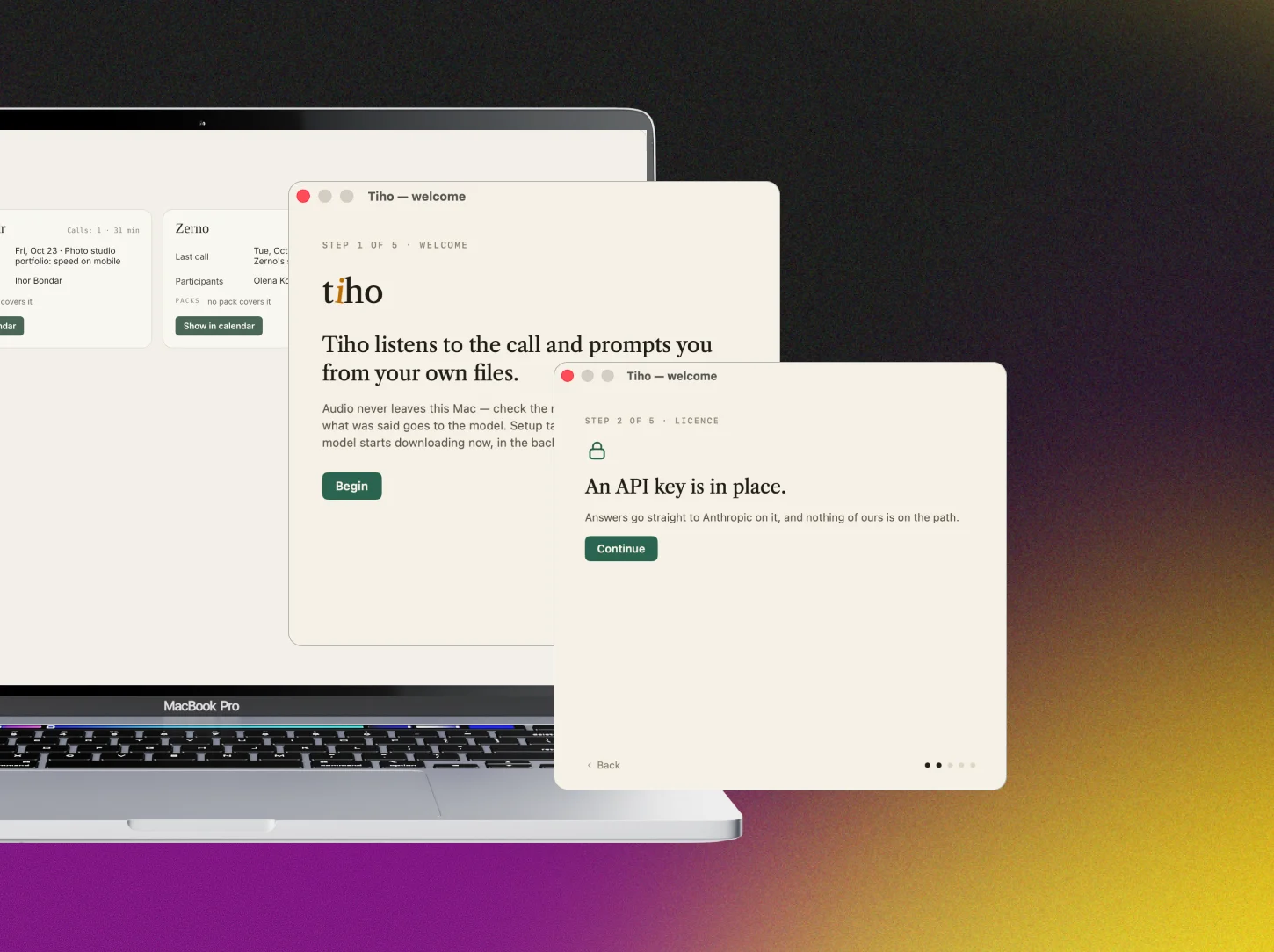
Tech stack. AI: whisper.cpp (large-v3 with VAD, running on Metal, measured at 10.2x realtime on an Apple Silicon Mac) and Anthropic Claude Sonnet 4.6 through an API key, so answers go straight to Anthropic. App: Swift and SwiftUI, Node.js, ffmpeg, Apple EventKit, Core Audio, ScreenCaptureKit and the Notion SDK for the optional integration.
Timeline and team. Work on Echo started on June 19, 2026. All four of its phases (pipeline, native app, automatic call detection and calendar enrichment) were ready and tested on real calls by early September 2026. Echo and Sufler were then merged into one app, and Tiho is now in public beta at tiho.dev, with a waitlist and 10 free calls at launch. The team: one engineer working with AI coding agents as a pair.
Result. Between June 24 and October 15, 2026, Echo filed 149 calls, about 40 a month, all of them with zero manual steps. A quick answer reaches the screen in about a second and a full briefing in two to three seconds, in any of 14 languages. Transcription costs nothing, because it runs on the Mac.
Hotel booking support: Rails first, AI on top
Industry and target user. Travel and online hotel booking under dozens of brands, B2C and white-label for partners. Built for the support team and the operations department. The guests waiting for a booking confirmation benefit at the end of the chain.
The challenge. Hotel confirmations ran by hand. An operator emailed the hotel, waited, called back and retyped the status into the operations platform. Every email carried a risk of a duplicate or a lost reply, and the booking status got lost somewhere between the mailbox and the operations platform. Requests were prioritized by eye, with no SLA. The company had no dedicated support system: Everything lived in shared mailboxes and the operations platform.
The AI solution. The new system brings shared mailboxes, guest conversations, SLA-based prioritization and an automated confirmation process into one place: an email to the hotel, reply tracking, retries and escalation to a person.
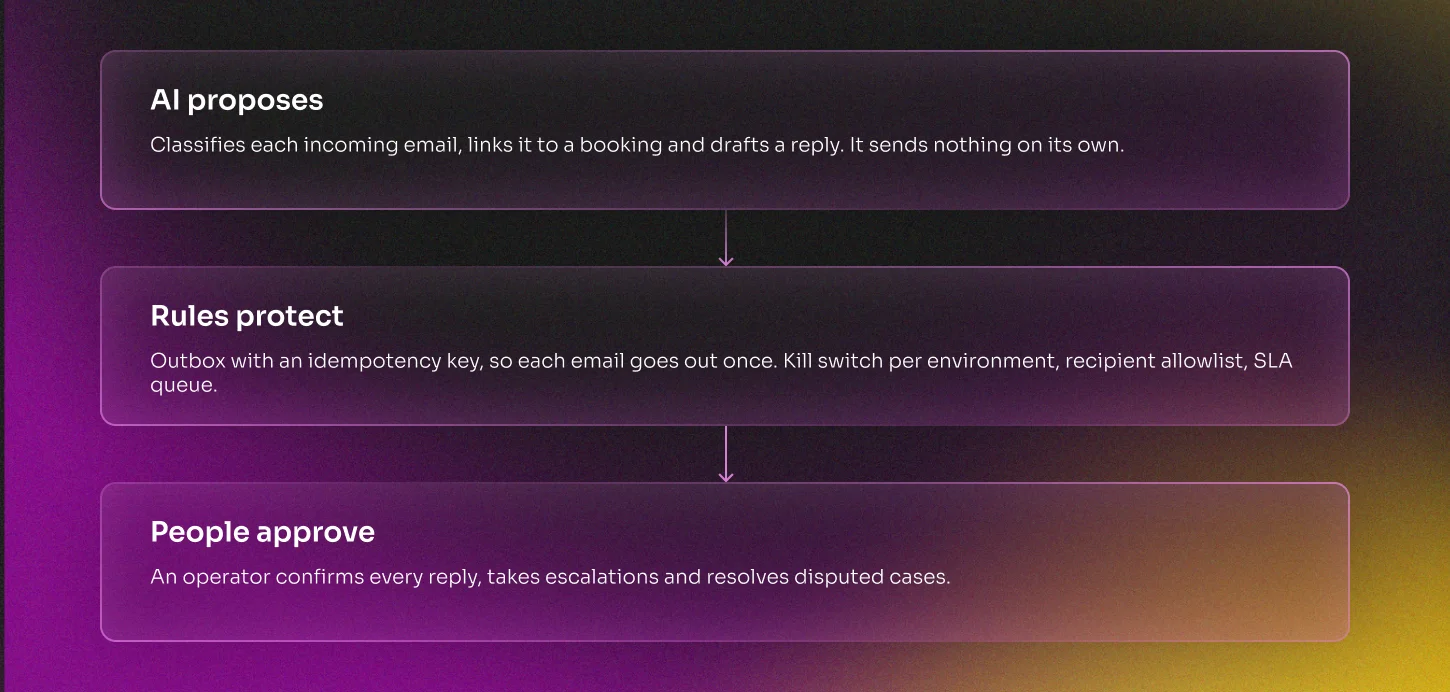
The deterministic layer came first, because this is the part that talks to people outside the company:
every outgoing email follows the outbox pattern, with an idempotency key built from the booking and the attempt, so the same email can go out only once;
a kill switch per environment and an allowlist of recipients control who can receive anything at all;
retries and escalations run on a schedule, and the request queue follows SLA priority;
lists and background jobs work in bounded batches everywhere.
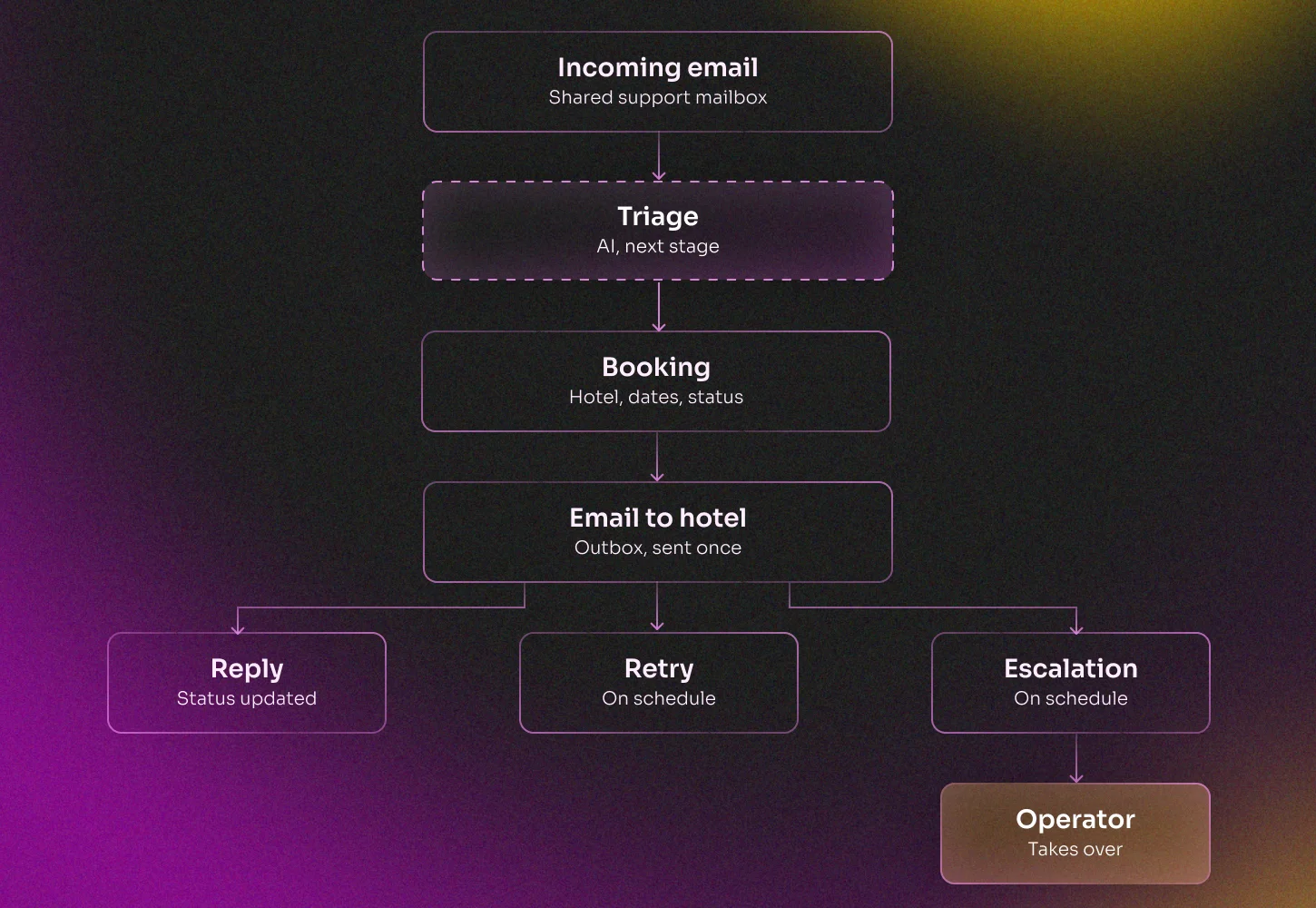
The AI customer support automation layer is built into the architecture as the next stage. A model will read each incoming email together with the booking context (hotel, dates, status) and return a category, a priority, the linked booking and a draft reply. It sends nothing on its own: An operator confirms every reply before it leaves. People also take every escalation and resolve disputed cases.
Tech stack. AI (planned): Anthropic Claude, with the built-in AI features of Zammad as an option. Product: .NET 9 API (EF Core, Postgres, outbox and background jobs), React 19 with TypeScript (Vite, TanStack Query, Tailwind), Zammad open-source helpdesk as a candidate base.
Timeline and team. Work started in September 2026. The team: a lead engineer, a second engineer and a DevOps specialist.
Result. The confirmation workflow with the outbox, retries and escalation is built ahead of the pilot. Outgoing email to hotels stays switched off in production until the support team signs off, and the AI triage layer goes on top of these rails as the next stage.
What these four projects have in common
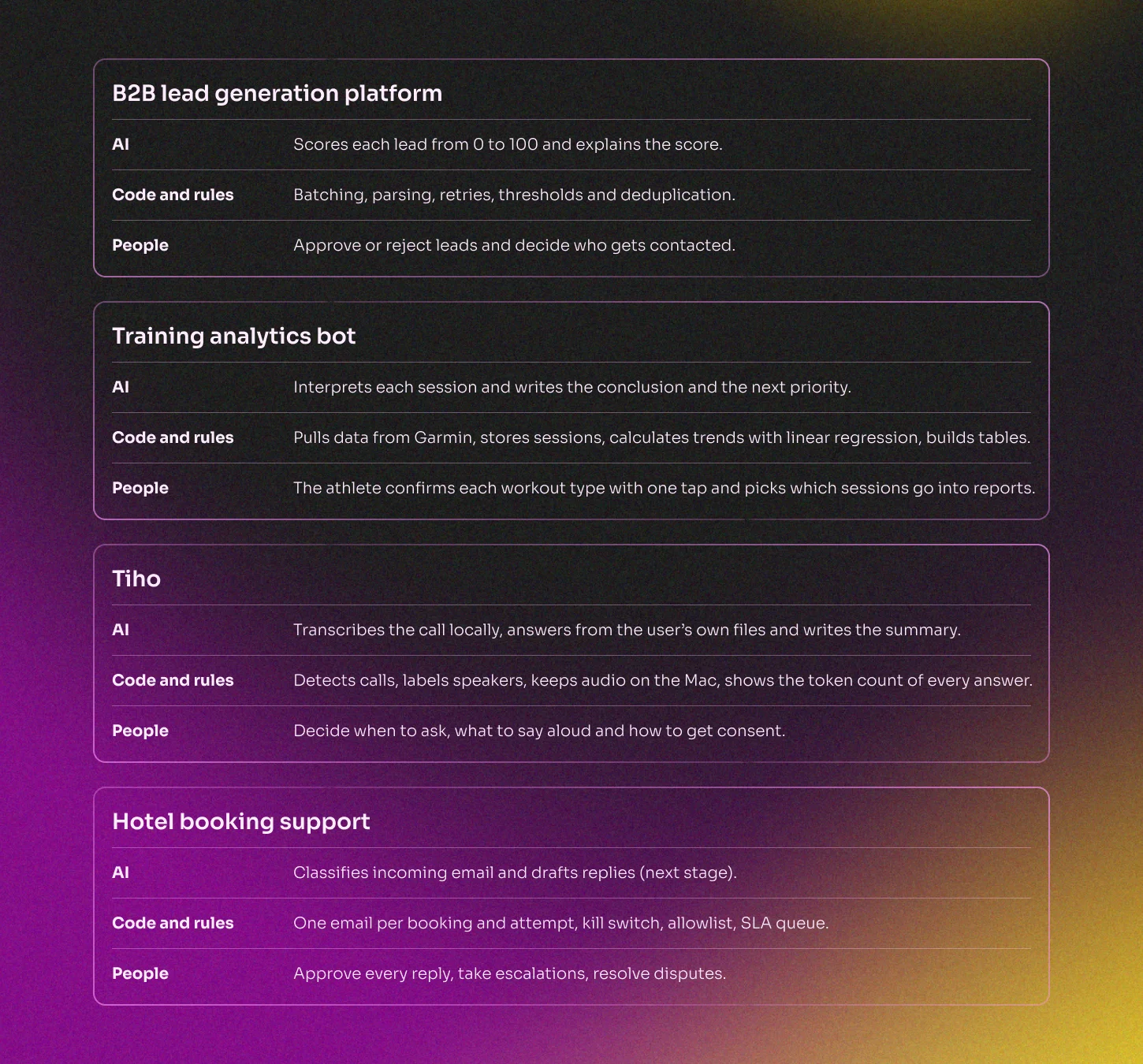
The four projects solve different problems in different industries. The structure underneath them repeats: a narrow AI step, a deterministic layer that keeps it reliable, and a person at the points where a mistake would cost the most.
B2B lead generation platform. AI scores each lead and explains the score. Code owns batching, parsing, retries, thresholds and deduplication, and people decide who gets contacted.
Training analytics bot. AI interprets each session and writes the conclusion. Code pulls the data, calculates trends with linear regression and builds the tables, and the athlete confirms each workout type with one tap.
Tiho. AI transcribes the call, answers from the user's own files and writes the summary. Code detects calls, labels speakers, keeps audio on the Mac and shows the token count of every answer.
Hotel booking support. AI will classify and draft replies. Code guarantees one email per booking and attempt, and an operator approves every message to a guest or a hotel.
How we approach AI automation at Leetio
These projects follow the same working order, and it is the order we use whenever a client asks us for business process automation with AI.
Map the process and mark the risky steps. Before any model work, we list every step and mark the ones that reach people outside the company or are hard to reverse. In the hotel booking system, the email to a hotel was that step, and it got an outbox, an allowlist and a kill switch before anything else.
Give the model one narrow job and a format code can read. In the lead generation platform, the model scores and explains. A simple line-based answer format replaced JSON and brought parsing success to about 98%. In the training analytics bot, trends come from linear regression in code, so the numbers stay reproducible.
Build the rails around it. Queues, batching under a token budget, retries and recovery of stuck jobs are what turned a demo into a pipeline processing about 160 leads a minute.
Measure cost per unit from day one. About $0.00015 per lead and a token count on every Tiho answer are numbers a business can plan around.
Keep people at the decisions that matter. Sales teams approve leads, operators approve replies, athletes confirm each workout type, and Tiho users decide when to ask and what to say aloud.
A typical first step is a short discovery call where we go through one process together and point out which step AI should take and which steps belong to code and people.

Final Thoughts
AI automation pays off when the model gets one clear job and everything around it is engineered to hold up under real volume. In the B2B lead generation platform, the model scores leads, and the jump to about 160 leads a minute at $0.00015 per lead came from batching, a line-based response format and automatic retries. In the training analytics bot, a 20 to 40 minute manual review after every workout became a Telegram message that compares the session with the last 5 of the same type, while trends stay with linear regression in code. Echo filed 149 calls with zero manual steps, and Tiho, which grew out of it, puts a ready-to-say answer on screen in about a second while call audio stays on the Mac. In the hotel booking support system, the outbox, the allowlist and the kill switch went in before the first line of AI code, because an email to a hotel cannot be called back.
The model is the smallest part of each of these systems. The part that decides the outcome is the split: what AI does, what code guarantees and where a person signs off.
FAQ
- Start with a process that repeats often, follows a clear pattern and has one step that needs judgment, such as qualifying a lead, classifying an incoming email or summarizing a call. That judgment step goes to the model. The repetitive steps around it, like collecting data, routing and sending, are usually better handled by code.
- It depends on the scope and on what already exists. In the cases above, a personal training analytics bot went from an empty folder to a working cycle in a few days, the lead generation pipeline went from a broken prototype to a working pilot in about six weeks, and Tiho grew from an internal call-notes tool in June to a public beta by October.
- The cost stays low when the step is narrow and the requests are batched. In the lead generation pipeline, validation costs about $0.00015 per lead on Claude 3 Haiku, at around 4,500 tokens per batch of 8 leads. Measuring the cost per unit early makes the budget predictable.
- A demo runs a few requests. Production runs thousands, and every weak spot shows up: model answers in a format the code fails to parse, rate limits, jobs that hang mid-run. The fix is engineering around the model: a format that parses reliably, batching under a token budget, retries and automatic recovery.
- For anything that leaves the company, we use a human-in-the-loop AI setup and put hard limits in code. In the hotel booking system, AI only drafts replies, an operator approves each one, and an outbox with an idempotency key guarantees each email goes out once.
- Yes, with the right split between local and cloud steps. Tiho transcribes call audio on the Mac with an open-source model and sends only text to the LLM, so recordings never leave the device.